Eagle Wireless lands $25 million from The O.H.I.O. Fund to scale U.S. cellular module production
The Solon-based manufacturer — the only Western module vendor serving both IoT and automotive — closed a $30M Series B as federal regulations force OEMs to cut Chinese connectivity components from their supply chains.

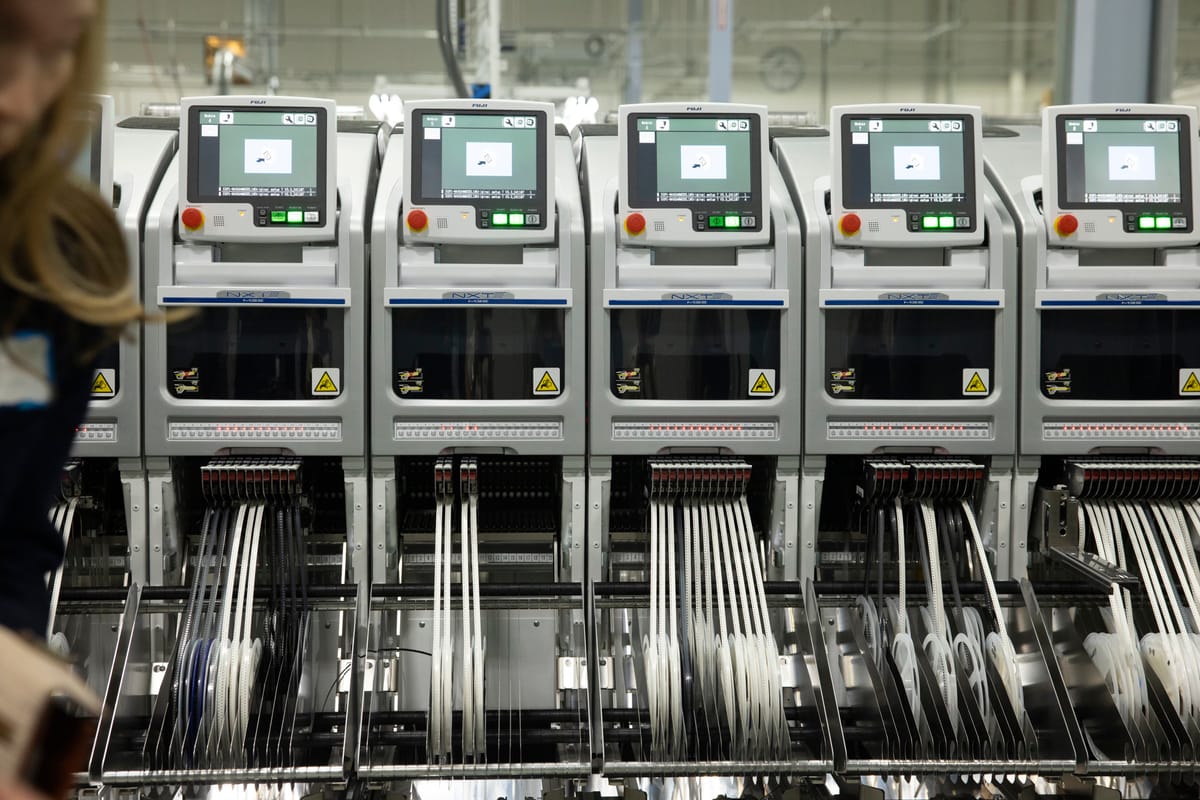
Solon-based Eagle Wireless has closed a $30 million Series B — with $25 million of it coming from private funds advised by The O.H.I.O. Fund — as tightening federal regulations force automakers and device makers to rip Chinese and Russian connectivity components out of their supply chains.
The investment, one of The O.H.I.O. Fund's largest single bets, was joined by Asymmetric Capital Partners and brings Eagle's total capital raised to $44 million. The company plans to use the funds to expand R&D, advance its 5G roadmap, and begin offering full-device production to U.S. customers — a strategic leap beyond its core cellular module business.
Why it matters
The U.S. Connected Vehicles Rule, which took effect in March 2025, is systematically cutting Chinese and Russian-made connectivity hardware and software out of American vehicles.
Automakers now face aggressive compliance timelines, with software and hardware restrictions phasing in over the next few model years and full compliance expected by 2030. That regulatory shift has created a vacuum for trusted, Western-controlled module suppliers — and Eagle is positioning itself as the company to fill it.
"Eagle Wireless is uniquely positioned to strengthen domestic technology and manufacturing capabilities," said Mark Kvamme, The O.H.I.O. Fund CEO & Chief Investment Officer. "By leveraging the company's proven cellular modules and customer relationships to support full-device production in the United States, Eagle is helping customers reduce supply chain risk while building critical connectivity infrastructure here at home."
The strategic shift
Eagle isn't just making modules anymore. The Series B signals a move from component supplier to full-device manufacturer — think complete telematics control units, not just the chips inside them.
That's a substantially larger addressable market and a deeper relationship with OEM customers who increasingly want a single Western partner for the entire connectivity stack.
"From day one, we've focused on building durable customer relationships through the cellular module," said TJ Dembinski, Co-Founder and President of Eagle Wireless. "This raise allows us to extend that value beyond modules and into full-device solutions, helping customers simplify development, accelerate deployment, and meet the growing demands of 5G connectivity."
By the numbers:
- $44 million: Total capital raised to date
- $100 million+: Anticipated module run-rate revenue over the next 12 months
- Founded 2024: Ohio production began July 2025
- Only Western cellular module vendor serving both IoT and automotive markets
How they got here
Eagle's trajectory has been unusually fast for a hardware company. Founded in 2024, it raised $14 million to build a manufacturing facility in Solon and began production in mid-2025.
Then came the December 2025 acquisition of German firm Wireless Mobility — a deal that rebranded the company as Eagle Wireless and added a global R&D footprint spanning North America, Europe, and Asia-Pacific.
The acquisition brought an established portfolio across 4G, 5G, and low-power wide-area technologies, along with blue-chip customers including AT&T Connected Solutions and fleet management giant Geotab.
The Ohio angle
Eagle's rise fits a broader pattern across the state's advanced manufacturing sector. Ohio has attracted a growing cluster of semiconductor and connectivity players, from Intel's massive fab complex in central Ohio to the defense manufacturing buildout underway with firms like Anduril.
Eagle occupies a specific and increasingly strategic niche: the cellular modules that sit inside nearly every connected device on a network, from fleet-tracking dongles to next-generation vehicles.
The O.H.I.O. Fund's continued backing reinforces the state's role as a hub for the kind of critical hardware manufacturing that Washington wants built on American soil.
What to watch
Whether Eagle can convert its module customer base into full-device production contracts. If the playbook works, Solon becomes a critical node in America's reshored connectivity supply chain.