How a recent Case Western graduate is helping a Midwest software firm bridge artificial intelligence and quantum computing
Merging physics theory with shipping code requires a rare dual mindset. MorelandConnect Chief AI Architect Caden Kacmarynski explains why AI and quantum computing are converging tracks for the region. He details how a physics-first approach helps industries prepare for a hybrid future.

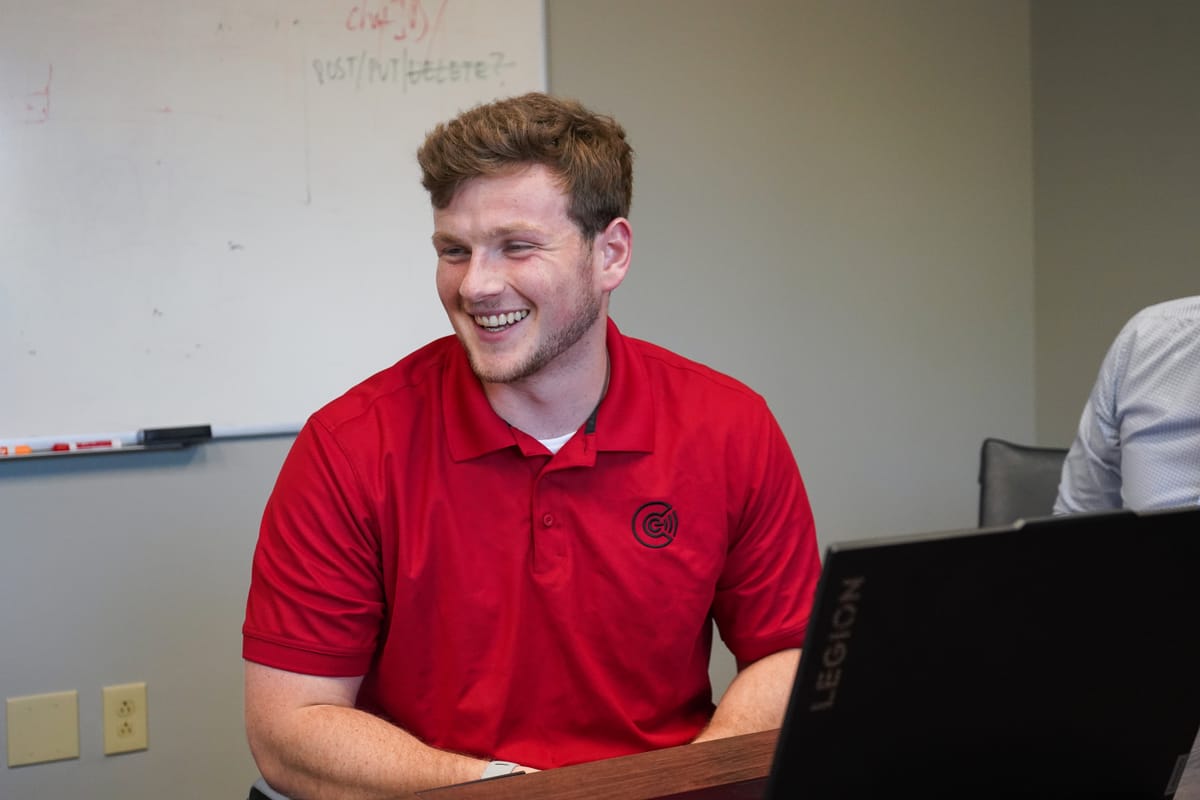
From a whiteboard crowded with matrix symbols to a kanban of delivery deadlines, Caden Kacmarynski moves easily between theory and shipping code. That duality—physicist and builder—explains why a 20-year-old Ohio software firm hired a newly minted engineering physics graduate to help lead its next act in artificial intelligence and, increasingly, quantum.
“My current title is Chief AI Architect at MorelandConnect,” he says. The company, he explains, began as a custom software firm, but now has pivoted into a tech-first, AI-based consulting company, delivering custom solutions. He also serves as chair of the nonprofit board of the Quantum Coalition, a global, student-rooted network that aims at “lowering the barrier to entry in quantum computing and quantum information sciences.”
If that sounds like two careers at once, that’s the point. In Kacmarynski’s mind, AI and quantum are converging tracks. “Two of the most important things… over the next 10 and 50 years plus, really, for humanity, will be AI and quantum computing,” he says. His job, on both fronts, is to make the complex usable.
From lab benches to delivery sprints
Kacmarynski is a recent graduate of Case Western Reserve University—B.S. in Engineering Physics (’24)—and an M.S. candidate in Entrepreneurial Physics. His master’s thesis? “The commercialization of the Quantum Coalition.” He cut his teeth in hands-on research at Case, as well as at Argonne National Lab. That bench-level work now informs a pragmatic posture inside a client-facing shop.
At MorelandConnect, he leads design on generative-AI systems, decision-support, and automation for healthcare, manufacturing, and enterprise. The company’s bet is that Midwest industries are ready for AI done with security, domain context, and speed—and that the firm’s physics-heavy leadership can peer a half-step ahead. “Not only are we software developers,” Kacmarynski says, “but Justin, our CEO, and myself are both physicists, and we have engineers on the team who are able to think beyond the possible, and beyond the classic.”
That phrase he tested in the interview, “building quantum-inspired solutions for Midwest industries”, is his north star. In practice, it means embedding quantum thinking where it already helps (optimization, security models, sampling) while preparing clients for a world where classical and quantum systems operate together. “We will have a quantum computer paired with a classical computer,” he says. Think QPU next to GPU: “Similar to how you plug in a GPU you could use a QPU, a quantum processing unit, and get more compute for more complex problems.”
His favorite analogy is tactile: “You could think of a quantum computer as a laser, and a normal computer as a light bulb. We have light bulbs in every room, lasers are much more powerful but we don’t all need to carry a laser.” The message to clients: don’t wait for a “quantum laptop”; design hybrid architectures now.
The coalition builder
The resume line that travels furthest is the Quantum Coalition, which Kacmarynski co-founded and now chairs. The roots trace to pandemic-era student organizing: “The original thought came around 2020 when Yale and Stanford did an online hackathon,” he recalls. That one-off became an annual rhythm—QC Hack, then SQUID (an undergraduate-led online research conference), and in 2024 the format he pitched and directed: QRISE—Quantum Research and Industry Skills Exchange. The tweak was intentional: stretch engagement across six weeks and pair student teams with industry mentors. “What if we took a hackathon and spread it out over six weeks,” he asks, “and tried to give people a longer-term engagement with industry partners? So that’s what we did.”
In parallel, he stood up the Case Quantum Computing Club with a modest start—“like, 10 students I just grabbed some football player buddies of mine” and then re-engineered the on-ramps after early meetings devolved into linear-algebra firehoses. “We worked a lot on… introductory materials and hands-on experiments,” he says. Results followed: events with 50 to 100 people eventually led to 300 active members. The lesson, lower the barrier, now guides the Coalition’s playbook: an educational resource bank built from student-led material much more digestible than a textbook-first approach, plus clubs-to-industry bridges and open-source squads.
That same playbook of accessibility and collaboration now drives Kacmarynski’s work with the Quantum Coalition. What began as a handful of student clubs has evolved into a global network connecting universities, researchers, and industry mentors. The Coalition helped organize the UN-partnered FLIQ hackathon and presented at the AI for Good Summit in Geneva—evidence of how far the student-led movement has scaled. Next, it’s focusing on Quantum Ambassadors to pair campuses with industry mentors, open-source development squads, an AI-powered learning-resource hub, and micro-grants to fuel student-run events around the world.
Where the wins start: finance, healthcare, energy
Pressed for early use-cases, he highlights three sectors with strong Midwest relevance:
Finance is an optimization frontier. “J.P.’s massive in quantum,” he says of industry leaders exploring quantum‐optimization frameworks for portfolio selection and risk modelling. In parallel, studies using quantum annealers have shown feasibility for credit-scoring and constrained portfolio balancing in pilot settings.
Healthcare is another major focus—an area he touched through research and now applies via AI systems that support clinical decision-making and workflow automation. At the same time, quantum‐sensor technologies such as nitrogen-vacancy (NV) centers in diamond are already enabling biomedical applications like nanoscale magnetic sensing and enhanced imaging capabilities.
Energy closes the loop. “Right now the general approach on AI is to throw more data and power at the problem,” he explains. “Quantum-classical hybrid methods offer a way to rethink that.” Indeed, recent research shows that hybrid optimization frameworks can reduce energy consumption by up to ~30% and cut computation time by around 25% compared with classical-only methods.
And the message to Midwest industries is clear: quantum isn’t just a distant dream—it’s already seeding improvements in sensing, electronics, and specialized architectures that are shaping the next generation of tech.”
Talent, on-ramps, and the work ahead
If there’s a soapbox he’ll stand on, it’s workforce. Kacmarynski believes a large gap has opened between quantum jobs and qualified applicants. “There’s a huge, huge discrepancy between the amount of jobs in quantum computing and the amount of people to do them,” he says, pointing to a 2025 QED-C workforce report that identified thousands of open roles worldwide and called for more hands-on, experiential learning to close the gap. Crucially, he stresses that not every role is a Ph.D.: “We need engineers, we need technicians. Someone needs to set up the lasers, someone needs to set up the dilution refrigerators. You need the whole stack.”
His own origin story doubles as recruiting pitch. As a teenager he noticed Moore’s Law slowing: chips were “a few atoms wide,” electrons “tunneling,” and we were “entering into what’s called the quantum regime.” He surveyed the frontier—biological computing included—and chose quantum as the most plausible next platform. For today’s students, he argues, basic literacy will soon be table stakes. “Any student, ideally in high school, but for sure in college,” he says, should understand “what is a quantum computer [and] how could you use it,” much as we now expect baseline fluency in generative AI.
Why here—and why now
There is a civic arc to all this. Ohio’s anchors match early quantum and AI needs: research universities, NASA Glenn Research Center, Wright-Patterson Air Force Base, and outsized financial operations at home in Columbus, Cleveland, and Cincinnati. The jobs Kacmarynski describes—across labs, fabs, data centers, and software teams—map to the region’s strengths. The risk is complacency. “The longer we wait, the harder it would be to understand anything,” he says. Better to start with on-ramps, budgets, and pilots now—and widen the aperture so that more students see a place for themselves in the field.
For Kacmarynski, the work is as personal as it is professional. He sees every hackathon, every AI model, and every late-night experiment as part of a larger effort to make the future less abstract and more accessible. His mix of curiosity and conviction feels contagious—the kind of optimism that pulls people in and reminds them why invention matters. To him, Cleveland isn’t a place to leave for opportunity; it’s where new opportunity can begin. “We know the impact that it can have,” he says of quantum’s promise, “and we know that it’ll impact our clients and our industry.” For a generation of technologists growing up in Ohio, he’s proof that the frontier doesn’t only belong to Silicon Valley but that it can be built right here at home.