CWRU launches $2.5 billion campaign, opens $300 million Cleveland research hub
Shared laboratories will bring together 65 faculty members and 300 researchers working on batteries, robotics, advanced manufacturing and medical devices, while a Google partnership will provide AI tools and expertise. Students will gain hands-on experience alongside researchers across disciplines.

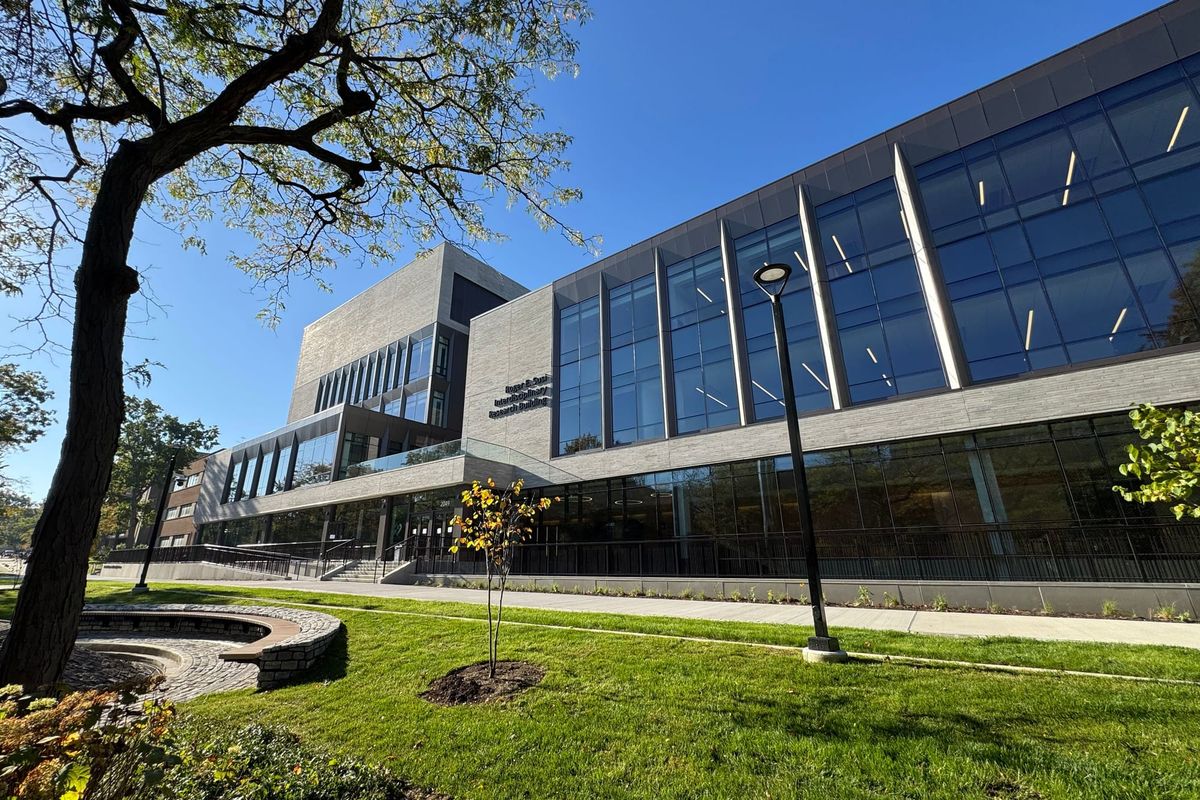
Case Western Reserve University is putting a $300 million research building at the center of a $2.5 billion fundraising push, expanding Cleveland’s capacity to develop energy technologies, advanced manufacturing processes and medical devices.
The university opened the Roger E. Susi Interdisciplinary Research Building on Oct. 21 and launched Breakthrough Point, which it calls the most ambitious philanthropic campaign in its 200-year history.
Driving the news
The 189,000-square-foot building is designed to bring together 65 faculty members, 300 researchers and students across shared laboratories and equipment.
Its namesake, medical-device entrepreneur and 1977 graduate Roger Susi, built a career turning engineering ideas into products for MRI settings. His work led to a vital-signs-monitoring device for MRI patients, and his current company, Iradimed, is known for its MRI-compatible infusion pump.
Susi and his wife, Kayoko, committed $25 million to the building in 2023 and added another $25 million. With matching support from CWRU’s century bond program, the university puts the combined impact of their gifts at $100 million.
By the numbers
- $2.5 billion: Breakthrough Point’s fundraising target.
- $300 million: Cost of the research building.
- $165 million: Donor support for the project, with the university’s century bond program providing the other funding.
- 11,000 square feet: Shared core facilities within the building.
- $1.82 billion: Amount raised by CWRU’s previous campaign, Forward Thinking, which concluded in 2019.
Why it matters for Ohio
The building adds research capacity in fields that connect to Ohio’s industrial and health care sectors: batteries, materials, manufacturing, robotics and medical technology.
The design brings researchers from different disciplines into shared spaces rather than separating their work by department. Core facilities will give university researchers and outside users access to specialized instruments and equipment.
CWRU also says a partnership with Google will provide advanced artificial intelligence tools and expertise.
Students will work alongside faculty and other researchers, adding hands-on laboratory experience to the building’s research mission.
Inside the research hub
Seven research clusters define the building’s scientific focus:
- Electrochemical engineering and energy science: Improving batteries, energy storage and semiconductor efficiency.
- Advanced materials and manufacturing: Developing better components and production processes.
- NeuroRobotics: Creating bio-inspired robots for applications such as retrieving harmful objects from the ocean floor without putting divers at risk.
- NeuroTechnology: Developing devices and technologies for stroke, spinal cord injury, movement disorders and cognitive decline.
- Precision diagnostics and therapeutics: Creating individualized approaches to assessing and treating disease.
- Molecular therapeutics: Developing drugs and other treatments and advancing them toward patient use.
- Climate and ecosystem science: Studying environmental change and ways to mitigate its effects.
The building also makes room for questions beyond technical performance. CWRU’s Experimental Humanities program will have space on the Eric & Jane Nord Family Floor, including the Jack, Joseph and Morton Mandel Studio. Fellows’ research subjects range from AI ethics to historical insights into the consequences of climate change.
The founder’s perspective
Susi’s investment builds on a $2 million gift in 2019 that established CWRU’s first-year engineering experience, giving undergraduates space for hands-on projects.
For the new building, he pointed to flexible laboratories and informal encounters as ingredients for collaboration.
“It starts with the open structure and just bumping into people. Then you go upstairs into these malleable labs,” Susi said in the announcement. “These collaborations should result in great research outcomes.”
The broader campaign
Breakthrough Point will support scholarships and fellowships, faculty and research mentors, discovery infrastructure, and advances in health care.
Alongside the Susi gifts, its lead commitments include a combined $125 million gift announced in April from the Jack, Joseph and Morton Mandel Foundation and the Jack, Joseph and Morton Mandel Supporting Foundation.
That commitment supports the Experimental Humanities program, a new humanities building, scholarship endowment capacity at the Mandel School of Applied Social Sciences and an endowed presidential chair.
Fred and Brittan DiSanto are co-chairing the campaign, with Roger and Kayoko Susi serving on its cabinet.
The building gives CWRU’s fundraising ambitions a working laboratory. Its longer-term significance will depend on what researchers do with that capacity: develop better treatments, build useful technologies and train the scientists and engineers who carry the work beyond campus.