Path Robotics signs deal with America's largest military shipbuilder
The Columbus-based welding AI company signed an MOU with HII, the nation's largest military shipbuilder, to bring autonomous welding to Navy shipyards. It's the second shipbuilding deal in a week for the startup, which has raised more than $300 million to modernize American manufacturing.

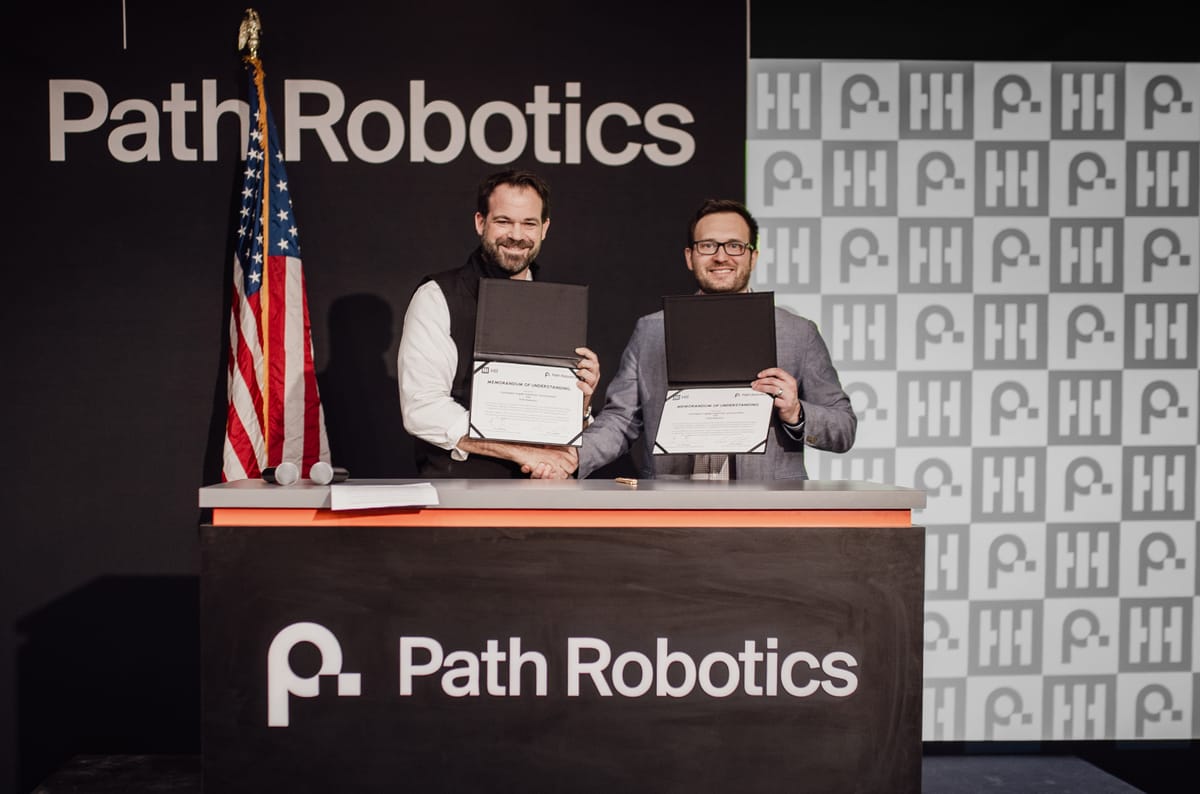
The U.S. Navy's push to outbuild its rivals is moving from the shipyard floor to the software lab. Path Robotics, the Columbus-based startup building physical AI for manufacturing, has signed a memorandum of understanding with HII (NYSE: HII) — the nation's largest military shipbuilder — to explore integrating autonomous welding technology into naval shipbuilding operations.
The MOU signing took place Tuesday at Path Robotics' Columbus headquarters, with Eric Chewning, HII's Executive Vice President of Maritime Systems and Corporate Strategy, and Andy Lonsberry, Path Robotics CEO and co-founder, in attendance. HII executives and local dignitaries toured Path's factory floor and observed welding demonstrations in the company's new intelligence center.
It's the second shipbuilding partnership Path has announced in less than a week — and a signal that Columbus-built AI is becoming central to a national effort to modernize American industrial capacity. The two companies first connected at The Reindustrialize Summit.
The details
Under the MOU, HII and Path will collaborate across three focus areas:
- Autonomous welding capability development for shipyard environments, using Path's Obsidian™ AI model — which uses proprietary sensing and computer vision to perceive a weld environment and adapt in real time, without requiring a pre-programmed path or CAD file. It handles the fit variations, complex joints, and different materials that make shipyard welding notoriously difficult to automate.
- Workforce training to extend automation across production, augmenting HII's skilled welders rather than replacing them.
- An intellectual property framework for physical AI-based welding systems, with R&D that extends to other shipbuilding technologies including HII's ROMULUS unmanned surface vehicles.
HII currently has dozens of ships in active construction or modernization across its yards. Its existing robotic welders — panel line units, cobots, and mechanized systems — all require significant human collaboration and follow pre-programmed paths. The company has not yet deployed an AI-based autonomous welding capability in its shipyards.
The momentum
The HII deal comes just days after Path announced a collaboration with Saronic, the Austin-based builder of autonomous naval vessels, to deploy intelligent welding cells at Saronic's shipyard in Franklin, Louisiana. That deal put Path's technology on the Gulf Coast for the first time and positioned it as a test case for a new generation of software-led shipbuilding.
Now, with HII, Path is working with a defense prime that reported roughly $12.5 billion in revenue in 2025 — an 8.2% year-over-year increase — and employs a workforce 44,000 strong. HII builds everything from Virginia-class submarines at Newport News Shipbuilding in Virginia to destroyers and amphibious assault ships at Ingalls Shipbuilding in Mississippi. The company reported a 14% increase in shipbuilding throughput in 2025 and is targeting another 15% gain in 2026. It's an aggressive ramp driven by the U.S. Navy's push to expand fleet capacity amid rising geopolitical tensions.
"By working with new partners like Path Robotics, we can further accelerate shipbuilding production," Chewning said.
Why it matters
The throughline connecting Path's recent deals is the same problem that runs through nearly every corner of American manufacturing: there aren't enough skilled workers to meet demand, and the gap is widening.
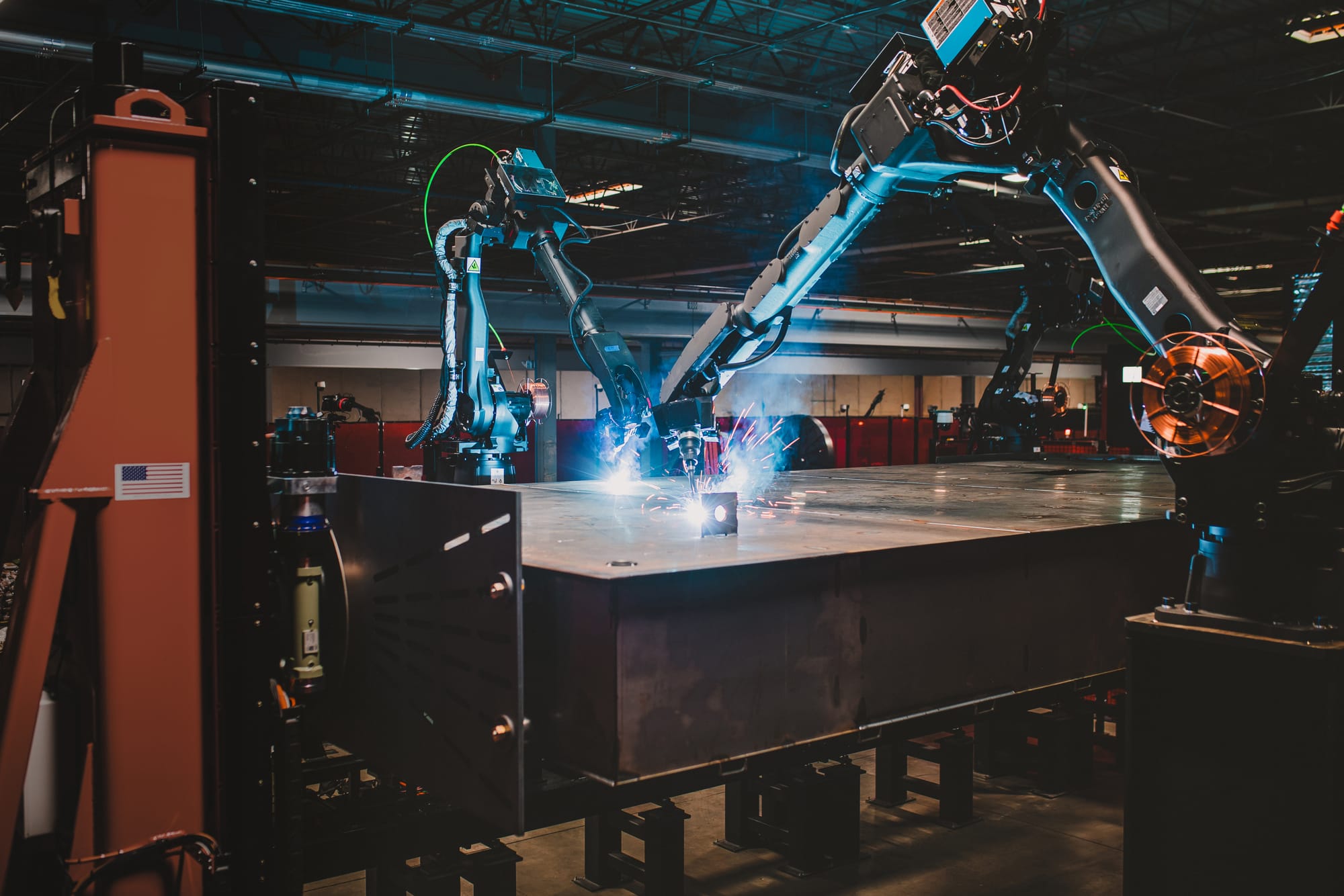
The American Welding Society has projected that more than 300,000 new welding professionals will be needed in the coming years, with the average welder in the U.S. now in their mid-50s and a significant share of the workforce approaching retirement. Path has warned the gap could reach as high as 600,000 by 2030. In shipbuilding specifically, the Navy has been in fierce competition for the same constrained labor pool as it works to dramatically increase ship production rates. It's a priority sharpened by the growing competition with China's rapidly expanding fleet.
That's the structural tailwind behind Path's business. The company isn't replacing welders, it's building systems designed to multiply the output of those who remain, taking on the repetitive and variable work that's hardest to staff while freeing skilled tradespeople for the most complex tasks.
"Welding is one of the hardest processes to automate in any industry, and shipbuilding is no exception," Lonsberry said. "Path's physical AI is purpose-built for that challenge — seeing, understanding, and adapting to real world conditions in real time."
The bigger picture
Path Robotics was founded in Cleveland in 2018 by brothers Andy and Alex Lonsberry while they were pursuing PhDs at Case Western Reserve University. The company has since raised more than $300 million in venture capital, including a $100 million Series D round in late 2024 led by Matter Venture Partners and Drive Capital, with participation from Yamaha Ventures, Taiwania Capital, MediaTek, Tiger Global, and others.
That fundraising trajectory — from a seed round backed by Lemnos to a nine-figure growth round — tracks with the broader reindustrialization thesis that has reshaped venture capital over the past several years. The CHIPS and Science Act, the Infrastructure Investment and Jobs Act, defense spending expansion, and reshoring momentum have created a massive demand signal for automation technology that can make domestic manufacturing competitive at scale. HII itself is leaning into this shift: its Mission Technologies division surpassed $3 billion in revenue for the first time in 2025, driven by demand for autonomy, unmanned systems, and electronic warfare — a sign that the shipbuilder is increasingly becoming a technology company, too.
Path has also launched Path Foundry™, a contract manufacturing entity that lets companies access its autonomous welding capability without buying equipment — a robotics-as-a-service model that lowers the barrier for manufacturers looking to automate.
The Ohio angle
While the welding work is happening on shipyards in Mississippi, Virginia, and Louisiana, the intelligence powering it — the vision systems, the machine learning models, the software architecture — is a Columbus product. Path's headquarters, its engineering team, and its new intelligence center are all Ohio based.
The HII partnership is the most prominent validation yet of what Path has been building toward since 2018: an autonomous manufacturing platform capable of operating at the scale and precision that national defense demands. In less than a week, the company has gone from announcing its first shipyard deployment with Saronic to signing an exploratory agreement with a $12.5 billion defense prime that builds nuclear submarines and aircraft carriers. The trajectory suggests Path is no longer a promising robotics startup, but that it's becoming a critical node in America's industrial base.