Sonic Fire Tech's NASA-inspired wildfire defense earns national recognition
This Cleveland startup uses NASA-inspired infrasound technology to neutralize wildfires without water or chemicals. Named a CES 2026 Innovation Award Honoree, Sonic Fire Tech leverages Ohio’s manufacturing base to scale its revolutionary acoustic suppression systems.

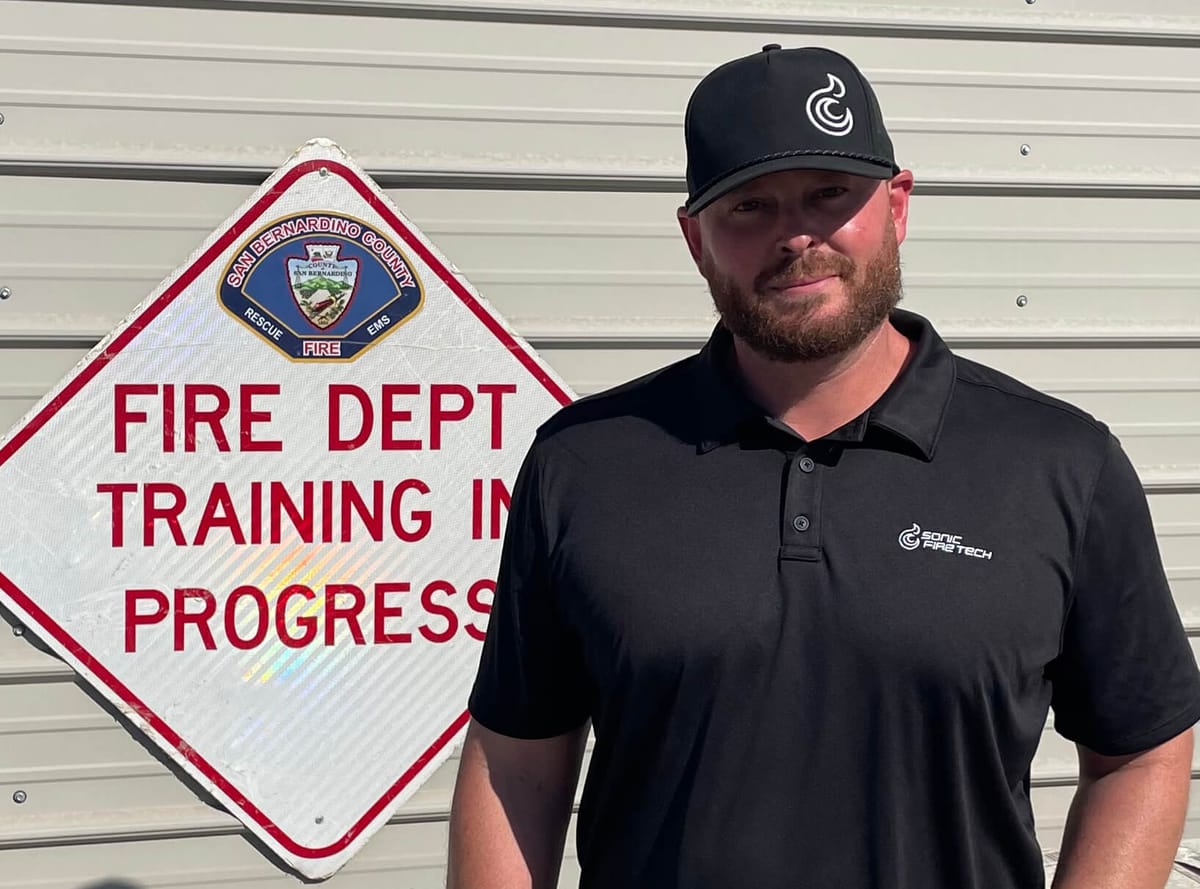
When Geoffrey Bruder started Sonic Fire Tech, along with co-founder Michael Thomas, in Cleveland in 2019, he brought with him the kind of expertise you don't find in most startup founders: years spent at NASA Glenn Research Center working on thermal energy conversion systems for planetary missions. That aerospace engineering background, combined with Cleveland's deep bench of manufacturing capabilities, proved to be exactly what was needed to tackle one of the nation's most urgent climate challenges.
Now, the company has been named a CES 2026 Innovation Awards Honoree in the Smart Home category, recognition that validates both the technology and the potential market for proactive wildfire defense. For Bruder, the award represents more than just industry credibility. "It's a recognition that the tech is needed and unique to the problem," he says. "A lot of companies that fall into the wildfire mitigation bucket are tech seeking a customer. We've found a mass market for this."
From planetary systems to fire suppression
The technology itself is deceptively simple in concept but sophisticated in execution. Sonic Fire Tech uses infrasound — low-frequency sound waves below the threshold of human hearing — to neutralize embers before they can ignite structures. Traditional fire suppression is reactive, waiting until flames are established before deploying water or chemicals. Sonic's approach targets the oxygen molecules that fuel combustion, vibrating them faster than fire can engage with the fuel source.
"For a fire to exist you need heat, fuel, and oxygen," Bruder explains. "We're vibrating the oxygen quicker than the fire can engage with it." The system can detect and suppress a flame from 30 feet away, using machine learning to distinguish between controlled fire and genuine threats. Early attempts at acoustic fire suppression failed because they operated in audible frequency ranges that would damage hearing at the scale needed for effective suppression. Sonic Fire Tech's breakthrough came from designing acoustic generators that operate at high efficiency in inaudible ranges — technology directly informed by Bruder's NASA work on converting acoustic energy.
Cleveland's manufacturing advantage
Cleveland proved essential to getting the company off the ground. "Cleveland is a great place to build things," Bruder notes. "Every other building is a machine shop." That manufacturing ecosystem, combined with early funding from local sources and the Innovation Fund administered by GLIDE (Great Lakes Innovation & Development Enterprise) through the Ohio Third Frontier program, gave Sonic the runway it needed to develop and test prototypes. The company's technical team still includes current NASA Glenn employees moonlighting on the project and former NASA contractors — a talent pipeline that would be difficult to replicate elsewhere.
The company has since raised $3.5 million from investors including Khosla Ventures, Third Sphere, AirAngels, and GLIDE, and is now deploying systems across California. They're working with major utilities including Pacific Gas & Electric and Southern California Edison, and speaking with insurance carriers and federal policymakers about how acoustic suppression fits into comprehensive wildfire defense strategies.
An international market emerges
The timing couldn't be more urgent. The recent Los Angeles fires brought the threat into sharp focus — team members at Sonic Fire Tech lost homes in the Palisades fires, driving home both the human cost and the commercial need. California now mandates internal sprinklers for all new construction, but the roughly 16,000 homes built before 2012 in fire-prone areas lack both the required systems and the water infrastructure to support them. Sonic's waterless approach addresses that gap directly, and the company anticipates capturing a significant portion of that retrofit market.
But the opportunity extends far beyond California. Colorado is facing similar challenges, and the same conditions exist throughout the western United States and into Canada, as well as in South America, Australia, and other fire-prone regions globally. "We're speaking with home builders and seeing interest from markets we didn't initially target," Bruder says. “Needless to say, our inbox is full.”
For Ohio's innovation ecosystem, Sonic Fire Tech represents the kind of company the state needs more of: deep technical expertise commercialized into a scalable product addressing a massive market need. The company is currently working with Ohio-based suppliers on low-volume production as they scale toward mass manufacturing, keeping at least some of the economic impact in the state that helped launch them.
Bruder's advice to other Ohio founders working on climate resilience technologies: the path isn't easy, but the infrastructure exists to support ambitious technical ventures. Between the manufacturing base, the talent pipeline from institutions like NASA Glenn, and the early-stage funding available through programs like the Innovation Fund, Ohio provides a foundation for companies willing to tackle hard problems.
As climate conditions continue to shift and wildfire seasons intensify, the market for proactive defense systems will only grow. Sonic Fire Tech's CES recognition signals that the industry is ready for new approaches—and that Ohio innovation is leading the way in developing them.