The $100 million bet that Columbus can become America's startup capital
Ratmir Timashev is funding dedicated sales teams for 100 of the world’s best B2B software startups — built and paid for in Columbus — with a target of 2,000 new tech workers in the city within five years.

Ratmir Timashev is putting more than $100 million behind a single thesis: that the reason most B2B software startups fail has nothing to do with the product. It's the sales.
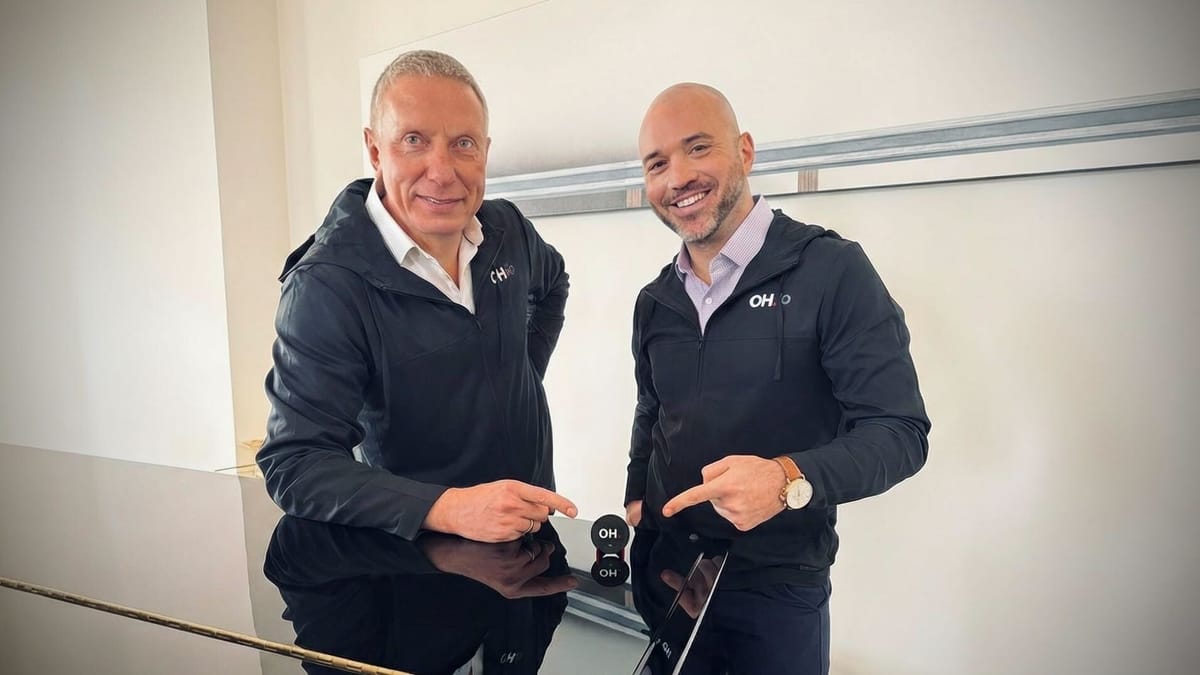
This week, Timashev — who co-founded Veeam Software in Columbus and grew it into a $5 billion company — and co-founder Jeff Schumann are publicly launching OH.io. The privately funded initiative, backed entirely by Timashev, plans to recruit 100 B2B software and AI startups globally, base their U.S. commercial push in Columbus, and staff sales and go-to-market teams that remain on OH.io's payroll. Participating companies the group says, give up no equity; instead, they share a portion of closed revenue. What OH.io is proposing might be called Revenue-as-a-Service.
Combined with the $110 million Timashev gave to Ohio State in 2023 to establish the Center for Software Innovation — the largest gift in the university's history — he has now committed more than $200 million to making Columbus a technology capital. He is currently the sole funder of OH.io.
The Man Behind the Money
Ratmir Timashev was born in Ufa, Russia, and immigrated to the United States in 1992, at age 26, to pursue graduate studies at Ohio State. He planned to get a PhD in chemical physics. Instead, while still a student in Columbus, he started a software company with his roommate. That startup, Aelita Software, was acquired by Quest Software for $115 million in 2004. Timashev then co-founded Veeam Software in 2006. Veeam became the global leader in cloud data protection, built its Americas headquarters in Columbus, and was sold to Insight Partners in 2020 for approximately $5 billion.
The trajectory — immigrant graduate student to billionaire software founder, all rooted in Columbus — is the kind of origin story that Silicon Valley builds mythologies around. Timashev has chosen to build something more tangible with it. His advantage is not just capital; it's that he has already built an enterprise sales engine before.
With two Columbus software successes to his name, Timashev decided to double down. He funded the Center for Software Innovation at Ohio State, which pairs engineering and business students with hands-on startup experience, and brought a Techstars accelerator to campus that invests in two cohorts of 10 startups each from across the world, a year. His stated goal at the inaugural Startup Midwest conference in 2023 was direct: "To make Ohio State, Columbus, and the Midwest the new high-tech mecca."
In 2024, Timashev became an American citizen. Today, Timashev sits on the advisory council of the Center for Software Innovation and on the Columbus Partnership, the Central Ohio CEO-led coalition that shapes the region's economic development. Columbus Business First named him to its "Power 125" list of the region's most influential leaders. But he is not just writing checks from the sideline — he still operates. He recently led Newo.ai's $25 million Series A. That company is working to scale AI voice infrastructure for small businesses. The pattern is consistent: build, invest, stay close to the work.
If Ohio State creates the talent pipeline, OH.io wants to build the commercial layer on top of it. The idea is that they can become the mechanism by which startups, and the local graduates who join them, actually build revenue.
"He wants founders all around the world to realize the American dream," Schumann said of his co-founder, "which he thinks Columbus and Ohio can play a real part in."
The Operator Who Already Proved It
If Timashev is the conviction and capital behind OH.io, Jeff Schumann is the operating proof that the model works. He is a graduate of Ohio State and a founder who built a revenue engine from nothing in Columbus once and is now proposing to do it a hundred times over.
Schumann co-founded Aware in a Columbus coffee shop with three partners, chasing what he describes as an idea they couldn't shake: that enterprises were sitting on a mountain of unstructured collaboration data with no way to understand or secure it. As CEO, he raised more than $100 million from Goldman Sachs and other top-tier investors, built a platform trusted by some of the most security-conscious brands worldwide, and grew Aware into a leading AI-powered contextual intelligence platform. Aware was acquired by London-headquartered Mimecast in 2024.
"Coffee shop to Fortune 100 customers to a landmark acquisition," Schumann has said. "I'll always be proud of the team that proved big, global companies can be built from Columbus."
The experience gave him an intimate understanding of the specific problem OH.io exists to solve. Building the product at Aware was hard, but building the sales motion — hiring the right people, finding the right messaging, identifying the right buyers, iterating through months of failed approaches before the pipeline finally started compounding — was harder. And he did it with significant venture capital behind him. Most early-stage founders are trying to crack the same code with a fraction of the resources.
"Many startup founders just don't have access to revenue in the early stage," Schumann said. "The compelling offering that we're creating is: we have the ability to offer you maybe the best non-dilutive capital you'll ever get. And that's revenue."

Schumann and Timashev have surrounded themselves with principals who share the same operator instincts. Alex Husted, a former digital health founder, joins as a General Partner after leading Ohio State’s venture capital and fund strategy. Kevin Colón joins as General Partner to lead the OH.io revenue engine, with more than 30 years of enterprise software revenue leadership, having served as CRO at multiple high-growth companies — including numerous successful startup exits — and held executive roles at Salesloft, Box, Oracle, and Informatica. Dhinuka Perera ran platform operations at Konvoy, a Denver-based VC firm, and started his career at South by Southwest (SXSW) as a lead conference programmer. Rounding out the leadership team is Seth Metcalf, who served as CFO and General Counsel of Bold Penguin, the Columbus InsurTech that exited successfully in 2021.
How the Engine Works
OH.io focuses on a specific type of company: B2B SaaS and AI-enabled software startups with recurring revenue models and sales cycles that require dedicated teams to build a pipeline, close deals, and expand accounts. This is not an effort for consumer apps, hardware, life sciences, or deep tech requiring lab infrastructure. It is built for the category where commercial execution is the difference between a good product and a growing company.
The mechanics start with recruitment. First, startups from around the world apply to OH.io, and after a competitive review and selection process, the team plans to onboard approximately 20 startups per year, reaching 100 within five years. For each company, OH.io hires a dedicated U.S.-based team in Columbus — averaging 10 to 20 people — and embeds them full-time with the startup they serve. These are OH.io employees, on OH.io's payroll, doing the daily work of prospecting, running demos, and closing deals. Most of the hires would be sales and go-to-market professionals, not software engineers. Current open positions include account executives, sales development representatives, and sales engineers — the full commercial stack a B2B startup needs to build a pipeline and close deals.
The model, the group says, is simple: OH.io embeds directly within portfolio companies, aligning incentives around revenue growth and long-term enterprise value creation.
OH.io covers salaries, benefits, and operational costs during an initial multi-year period. In the traditional venture model, a founder raises capital, hires salespeople with that capital, and hopes the team produces before the runway disappears. The investor's risk is the check. The founder's risk is everything else. OH.io absorbs more of the early risk: it bets its own capital on the team it built and earns a return only through a commission on the revenue that team generates. No equity. No dilution. No retainer.
The fine print — what counts as sourced revenue, how long the share lasts, and what happens when a company outgrows the arrangement — will determine whether the model scales. But the structural proposition is clear.
"We're betting on ourselves to succeed," Schumann said. "Our ask is as simple as: when the team helps sell your product and it goes well, you're paying a revenue share on that with us to help cover some of the costs. It's very outcome-based."
The early signal has come from an extensive European roadshow. OH.io has met with more than 30 venture capital firms across Barcelona, Berlin, Paris, Stockholm, and London, with planned trips to Tel Aviv. The reception has been striking—not just from founders but from VCs themselves.
"Most of the great VCs are saying they've always wanted something like this, but they haven't seen anything like this exist," Schumann said. International founders, in particular, are drawn to the proposition: they want access to the American market but have no idea how to build a sales operation here, and most of them have never heard of Columbus. OH.io offers a solution to both problems at once.
If the relationship succeeds, the trajectory is designed to be self-reinforcing. After a few years of embedded work, the OH.io employees driving revenue for a given startup would have the option to join that company's payroll permanently. The startup gets a proven team with institutional knowledge. The employee gets equity upside. Columbus gets another growing technology company with roots in the city.
"If the value proposition plays out the way we intend it to," Schumann said, "it's going to be going so well for the individual startup that the employee who's been helping them over the last few years is going to want to be part of that. And the startup's going to want them to be part of that."
Any startup can apply — OH.io is engaging with founders across the United States and internationally — but Schumann acknowledges the pitch may carry special weight abroad. "The real answer is we want the best of the best," he said, "that share in the idea that you can build an unbelievable company — probably build it with higher conviction, greater opportunity — out of the Midwest."
Why Columbus
Schumann’s passion and belief in this model are evident. But he makes the case with data, not sentiment.
Columbus has long been regarded as one of the most demographically representative metros in the United States — a claim that marketers and product managers have relied on for decades. It is the reason the city has historically been a test market for national brands, from fast food to retail to consumer products. Schumann sees the same logic applying to enterprise software: "If your product is taken to market here and goes really well, mathematically, it should go really well in any other city in America. There's not another city that looks like that."
For B2B SaaS companies, whose buyers are distributed across every industry and geography in the country, that structural advantage is particularly powerful — and it comes with an economic one. A 20-person sales team in Columbus costs a fraction of what the same team would run in San Francisco or New York, stretching OH.io's capital significantly further per company. OH.io intends to exploit both edges, making Columbus not just a test market but a permanent commercial launchpad for global software startups entering the American market.
Building the Ecosystem:The Grid and The Global Tech Event
The OH.io team has been studying what makes great technology cities. They have concluded that the most successful ones share a common feature beyond capital and talent: they have places where people physically collide. Silicon Valley has its campus cafeterias and Sand Hill Road. Paris has Station F. Atlanta has its Tech Village. Austin hosted South by Southwest, which began as a music festival and has since become a gravitational force that draws talent, capital, and ambition to the city.
Columbus, Schumann argues, does not yet have an equivalent. OH.io's answer is The Grid, a flagship innovation hub that will serve as the physical home for its portfolio companies, their embedded teams, and the broader startup community. The first location is being scouted in the Short North and near downtown, with a larger permanent presence planned for the Timashev building on Ohio State's campus.
The Grid is conceived as something beyond co-working: eventually, it will be multiple office locations spread out across the city where founders from different portfolio companies sit alongside each other, where visiting investors can walk a single floor and meet a dozen companies, and where the collisions that have historically been a primary advantage of being in Silicon Valley happen by design rather than geography.
OH.io also plans to host what Schumann described as "the United States of America's greatest technology conference and entrepreneurship event" in Columbus. It is a direct play from the South by Southwest playbook. Bring people to a city for an event. Let them fall in love with it. Watch them decide to build there.
"Because of our humility," Schumann said, "we're not telling the world how great Ohio is as often as we should. And certainly the world, if we are, is not paying attention."
The Fund
Most venture funds lead with capital and hope revenue follows. OH.io leads with revenue and deploys capital selectively.
The initiative is establishing a venture fund to invest directly in portfolio companies, but the fund is deliberately secondary to the engine. "We do not intend to invest in every single company that gets attached to this," Schumann said. "In fact, every single company that gets attached to this shouldn't want investment. The best form of investment, I would argue, is revenue."
The logic follows naturally from the model. If the commercial engine works as designed, many founders will find themselves with accelerated revenue, a proven team, and stronger economics — meaning they can delay fundraising or raise on significantly better terms. For companies that seek capital, OH.io will have the right to invest, partnering alongside other firms rather than necessarily leading.
"Rising tides raise all ships," Schumann said. While Timashev is the sole funder today, Schumann does not expect that to last. "While he'll start that way, I don't think it'll end that way." And the potential for outsized outcomes is embedded in the model: if even one portfolio company breaks out — Schumann floated the scenario of discovering "the next OpenAI out of Tel Aviv" and scaling it in Columbus — a single $75 million Series A could reshape the math for the entire region.
The Math That Matters
OH.io is launching this week, but it is not starting from zero. The team has grown to more than 35 employees over the past few months, and the initiative has been in development since 2025. Two companies — Newo.ai and Testkube — have already signed up for the program. Schumann and his team have completed an extensive international roadshow, and interest is building.
The pace is aggressive but measured: 10 to 20 companies in the first year, scaling to roughly 20 per year, with 100 as the five-year target. "There's going to be some years where it's 10 and not 20, and the next year is 30," Schumann said, "because we've got to build the credibility up front."
The open questions are real. Can OH.io recruit and retain the commercial talent required to staff teams for 20 companies a year — and where, exactly, do those people come from? The Center for Software Innovation at Ohio State is part of the answer, but scaling from a single university pipeline to 2,000 working professionals is a workforce challenge as much as a venture one. Can the revenue-share model sustain itself during the early quarters when sales cycles are long and the pipeline is thin? Can international founders be convinced not only to visit Columbus but also to establish permanent operations here?
Schumann is aware of the skepticism. He is also aware that the skepticism is, itself, the thing OH.io is trying to overcome.
"Ohio has been not as braggadocious as we probably should be," he said. "Because of our humility, it gets in the way. Oftentimes it's a great strength. And sometimes it's a great weakness. The world doesn't yet know how amazing this place is and could be."
But return to the math, because the math, and a $100 million seed investment, is what separates this from aspiration.
One hundred B2B software companies from Barcelona, Berlin, Tel Aviv, and beyond — each with a dedicated commercial team built and funded in Columbus. Those teams start on OH.io's payroll. Over time, they are absorbed into the startups they helped build. At full scale, the number approaches 2,000 new technology workers in the city. Companies and workers are not lured by tax incentives or relocation bonuses, but are anchored by a revenue engine that gives them a reason to come to Columbus and stay.
What Timashev and Schumann envision for OH.io and Columbus is not an ecosystem evolving. It’s the launch of America’s next technology capital.