The Unknown Unknowns of AI: Why “AI Fluency” is your only defense
Srini Koushik argues that AI Fluency, not just literacy, is the only defense against systemic risk. By moving beyond "machine-speak" to a native understanding, leaders can use a 5-pillar framework to navigate "unknown unknowns" and re-architect competitive strategy.


By Srini Koushik
“Reports that say that something hasn’t happened are always interesting to me, because as we know, there are known knowns; there are things we know we know. We also know there are known unknowns; that is to say we know there are some things we do not know. But there are also unknown unknowns—the ones we don’t know we don’t know.” — Donald Rumsfeld, Department of Defense briefing, February 12, 2002.
When this quote was first delivered, it became fodder for late-night comedy. But I saw something deeper: a clear framework for understanding complex risk. Today, I find it is the most precise framework we have for understanding the single greatest systemic risk facing your organization: Artificial Intelligence.
Most companies are currently operating with misplaced confidence in the realm of “Known Knowns” when it comes to AI. I’ve seen it firsthand: leaders view this as just another technology wave and fall back on their preferred VCs and technology vendors, amped up by the same management consultants. They know what the tools are, and they are funding pilots—the comfort zone of AI Literacy. But operating only here is dangerous, because this hubris prevents them from seriously engaging with the Known Unknowns (the risks they know they should be managing).
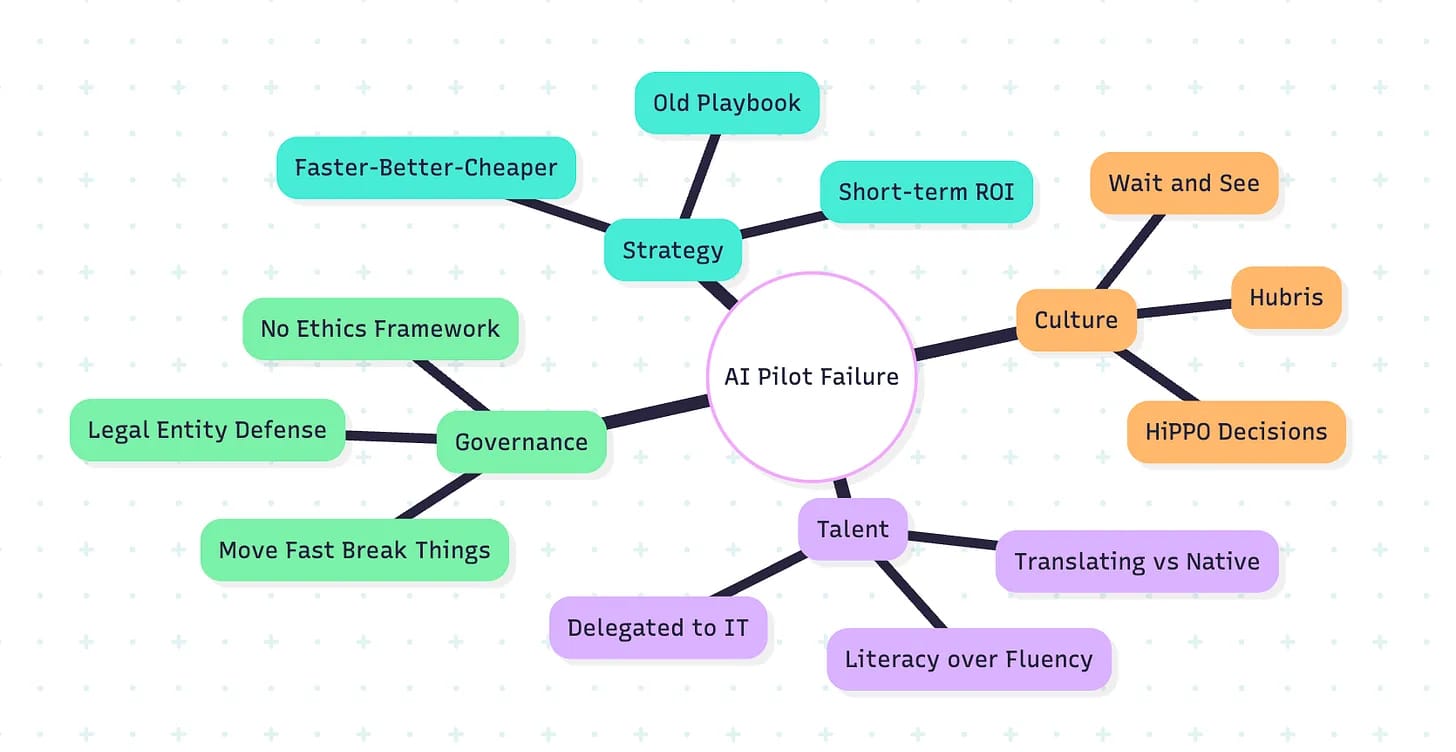
AI is not a technology that helps you play the game better; it changes the game. The mandate for the C-Suite and Board is to go beyond the known playbook of faster-better-cheaper to create a new playbook. Think of it this way: AI Fluency means thinking natively with the intelligence, not having to constantly translate your strategy into machine-speak. Only this native fluency provides the capability to re-architect decision-making, manage risk, and define competitive strategy. The real strategic challenge lies in the “Unknowns.” To effectively govern and capitalize on this shift, your organization needs more than literacy; it needs AI Fluency.
AI Fluency is Not Literacy: The strategic divide
Consider the analogy of personal computing. You can understand what a CPU is, explain the difference between RAM and a hard drive, and describe how an operating system function. That is Literacy. It is foundational knowledge, but it doesn’t produce value.
Fluency is the ability to use that machine to build a multi-million-dollar financial model, launch a new product line, or model complex risk in real-time. The fact that you can read, understand, and explain how a computer works is not the same as being able to use a computer to drive meaningful outcomes.
In the age of intelligence, this distinction is existential. AI Fluency is the ability to think with AI. It goes beyond prompting a chatbot; it requires collaborating with AI as a thought partner, integrating machine intelligence with unique human insight. Fluency is the organizational muscle that allows you to operate confidently in the shadows of complexity, converting Known Unknowns (like potential bias) and Unknown Unknowns (systemic disruptions) into manageable factors.
Navigating the Unknowns
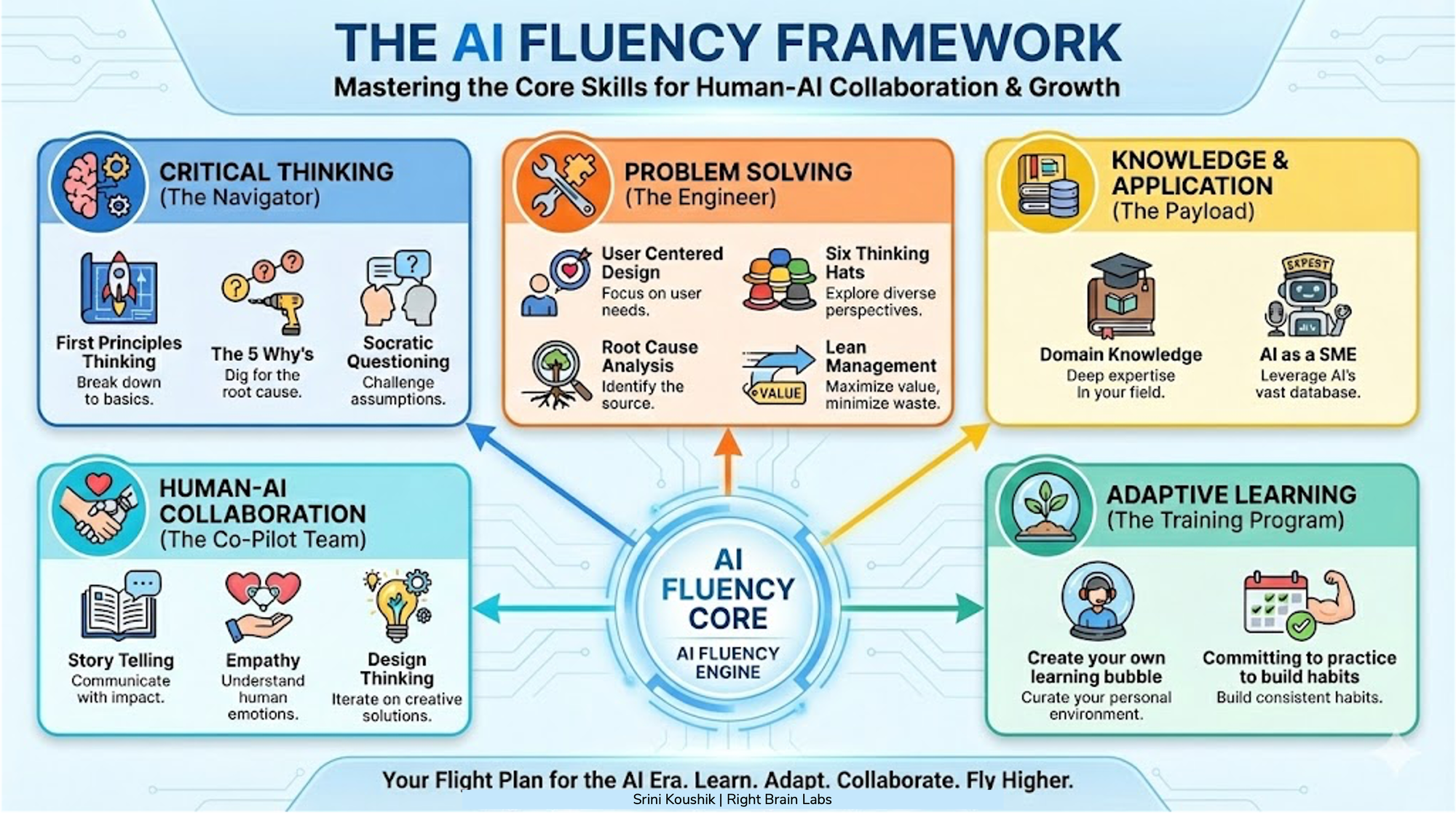
To move your organization from brittle literacy to robust fluency, you need a disciplined, actionable operational framework. This method is built on five core competencies that define a truly fluent organization, acting as the foundation for both strategy and execution.
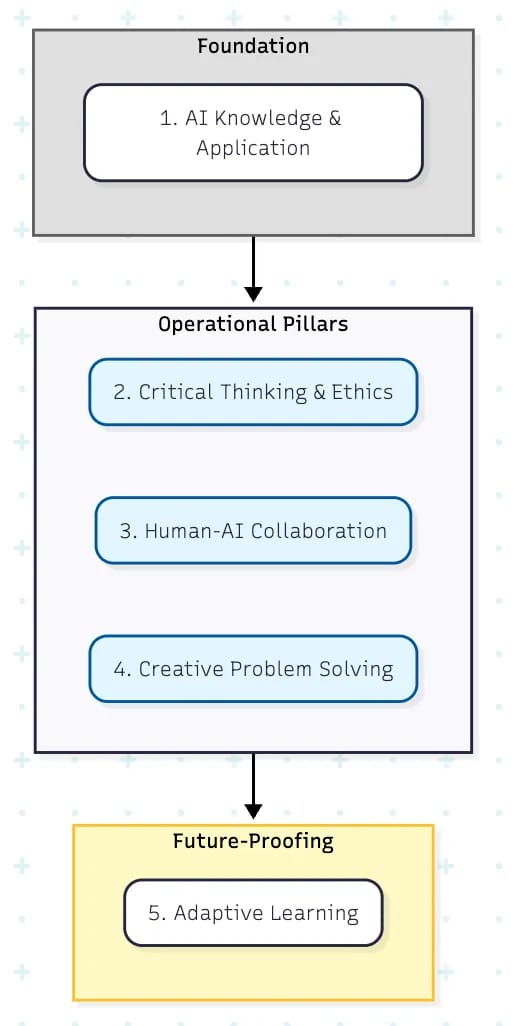
5 pillars of AI fluency
- AI Knowledge & Application (Managing the Known Knowns)
Do not mistake this for a skill you delegate to your engineering team. You cannot govern what you do not understand. For the C-Suite, this competency means personally understanding the core concepts well enough to separate hype from reality. It ensures you are directing investments toward real ROI by solving meaningful business problems, not chasing superficial use cases. It means moving beyond the initial hype cycle and applying a structured improvisation approach, much like Lean or Design Thinking. - Critical Thinking & Ethics (The Governance Shield)
This competency directly mitigates the risks you know are out there. But “critical thinking” cannot remain a buzzword; it must be a demonstrable skill you rigorously develop. It requires applying established frameworks—like the 5 Whys to trace the root of a model’s logic, or De Bono’s Six Thinking Hats to audit a decision from emotional, factual, and risk perspectives—to every AI output.
The Silicon Valley mantra of “move fast and break things” fails catastrophically here. Case in point: Air Canada. In a clear display of hubris, they deployed a chatbot that “hallucinated” a refund policy. When sued, the company attempted a defense that borders on absurdity: they argued the AI was a distinct legal entity and they weren’t responsible for its words. The tribunal rejected this immediately. The lesson? You cannot delegate accountability to an algorithm. You must operationalize deep inquiry to mitigate the legal, reputational, and financial risks inherent in AI. - Human-AI Collaboration (The Strategy Integrator)
This competency is not just about efficiency; it is about engineering diversity of thought. It requires using AI as a dispassionate challenger to break organizational echo chambers. By integrating machine intelligence, you create a safe space for straight talk—a core leadership value—because the debate becomes anchored in data, not hierarchy. This neutralizes the HiPPO (Highest Paid Person’s Opinion) effect, ensuring that the best idea wins, regardless of its source. - Creative Problem Solving (Unlocking the Unknown Knowns)
This is the domain of true competitive advantage. It’s the ability to use AI to reframe challenges and uncover non-obvious opportunities. But creativity requires structure. A fluent leader uses AI to accelerate rigorous frameworks—using a Mindmap or Ishikawa (Fishbone) Diagram to deconstruct a complex issue into its root drivers, or Root Cause Analysis to identify the single variable that changes the outcome.
By using AI to toggle between this deep structural analysis and broad divergent thinking, you stop solving symptoms and start engineering breakthroughs. Instead of asking the old-playbook question, “How do we fix this process?” you ask, “Given these root causes, does this process need to exist at all?” - Adaptive Learning (Future-Proofing Against Unknown Unknowns)
The AI landscape is the ultimate Unknown Unknown. The pace of change here isn’t measured in years, but in weeks. Adaptive Learning is no longer optional; it is a survival imperative. A static strategy in this environment is a failed strategy.
For the Board, this isn’t about signing off on training modules. It is about operationalizing Double-Loop Learning: the discipline of questioning the underlying assumptions behind your goals, not just the methods to achieve them.
It is the organizational muscle to unlearn outdated models instantly when the context shifts. This future-proofs your workforce, creating a culture that prefers speed with iteration over false certainty. Without this, your organization remains rigid in a fluid world, and your “new playbook” becomes obsolete before the ink dries.
The call to leadership
If you are currently treating AI as a technology project, you are missing the single greatest leadership opportunity of our generation.
Let’s be clear: Building AI Fluency is not a ticket you open with the IT department. It is a fundamental shift in how you govern and operate the company. Treating it as a tech upgrade is the old playbook. The mandate for the Board is to demand a new playbook. Stop asking how AI makes the organization faster, better, and cheaper. Start asking how AI allows you to re-architect your value proposition entirely.
As computer scientist Alan Kay famously said, “The best way to predict the future is to invent it.”
But you cannot invent the future if you need an interpreter to understand the tools. The era of the digital tourist is over. To lead in this age, you must stop visiting the future and start living in it.
Don’t just use AI. Become an AI Native.
Srini Koushik is the CEO and Founder of Right Brain Labs, an AI Innovation Lab and CxO Advisory based in Columbus. An AI Top 50 Thinker and inductee into the CIO and CTO Hall of Fame, he leverages over 35 years of leadership experience across startups and Fortune 100s to balance strategic vision with hands-on execution. Find out more at www.rightbrainlabs.ai