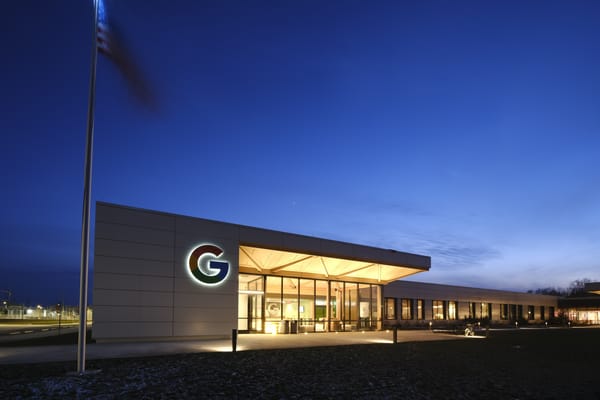
$500 billion AI complex coming to Ohio in historic energy and computing deal
SoftBank, AEP Ohio, and the federal government unveiled a 10-gigawatt data center and power generation campus — one of the most ambitious infrastructure projects ever announced in the U.S. — on a former Cold War site in southern Ohio.

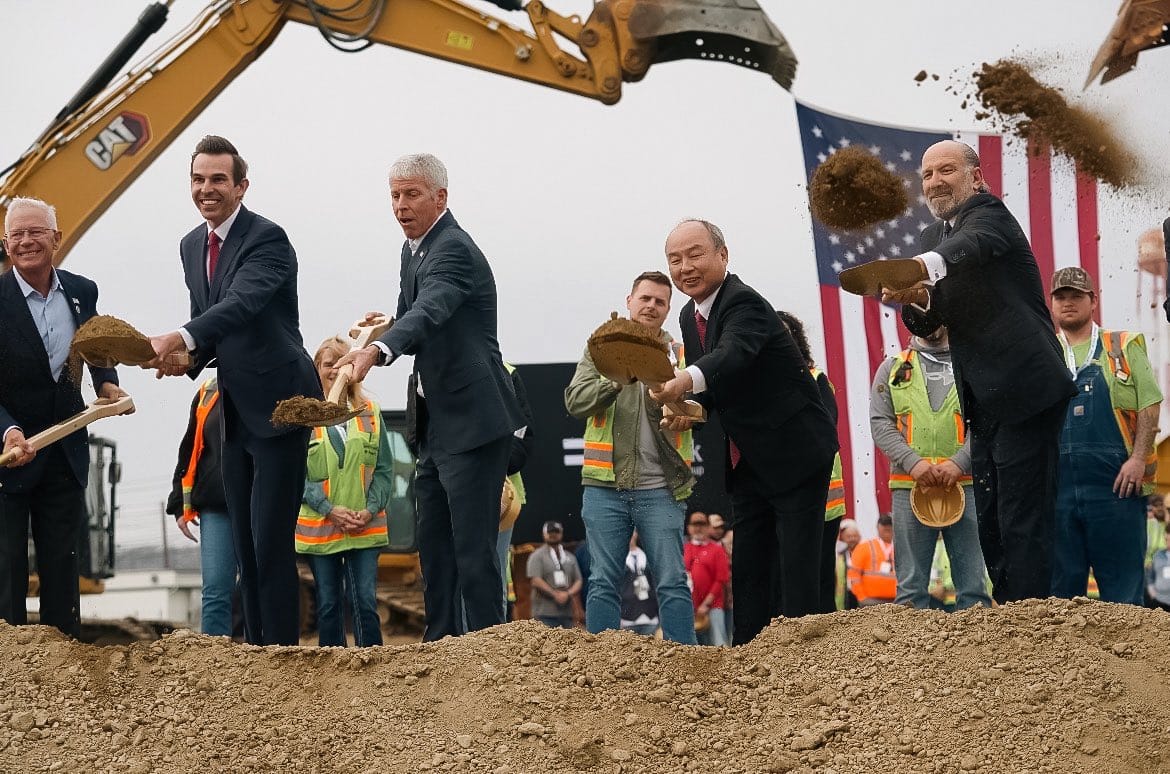
Three U.S. cabinet secretaries — Energy Secretary Chris Wright, Commerce Secretary Howard Lutnick, and Interior Secretary Doug Burgum — joined SoftBank CEO Masayoshi Son and AEP leadership to announce a public-private partnership that Son says could channel as much as $500 billion in total investment into Pike County, Ohio.
The deal is centered on the former Portsmouth Gaseous Diffusion Plant, a DOE-owned site that for decades played a role in the nation's nuclear program and now sits at the heart of an Appalachian region that has waited a generation for economic reinvention.
The project calls for the construction of a 10-gigawatt data center complex and an equally massive power generation facility on federally owned land. The generation fleet — featuring 9.2 GW of new natural gas capacity, with the remainder from other sources — would be among the largest such projects globally, according to federal officials. The first phase is expected to include roughly 800 megawatts of power, carry a price tag of $30 to $40 billion, and come online by early 2028.
Where the money comes from
The financial architecture is binational. A previously announced U.S.–Japan Strategic Trade and Investment Agreement committed $33.3 billion in Japanese funding specifically for the natural gas generation component. Commerce Secretary Howard Lutnick called the Japanese funding "a direct result of President Trump's America First trade policies," saying Japan has pledged to invest $550 billion across the United States, including the $33.3 billion tied to the Ohio power project.
On the domestic side, SB Energy is investing $4.2 billion in transmission infrastructure upgrades throughout southern Ohio — new lines and reinforced corridors designed to connect the campus to the regional grid. SB Energy and AEP Ohio say those upgrades will not raise customer rates and could help lower electricity prices in the region by adding capacity in a historically underbuilt part of the grid. AEP Chairman and CEO Bill Fehrman put it plainly: the partnership "unlocks billions of dollars of electric transmission infrastructure, all without increasing customer rates."
DOE says the power generation and grid upgrades will be financed "at no cost to American families," a structure designed to comply with President Trump's Ratepayer Protection Pledge, which bars shifting the cost of energy infrastructure tied to the technology boom to consumers. SB Energy has committed to making excess transmission and generation capacity available to the broader grid.
What It means for Pike County
Southern Ohio's Pike County, population roughly 28,000, has weathered decades of economic contraction since the Portsmouth enrichment operations wound down. The site itself has been the subject of lengthy environmental remediation. Now, the DOE's Office of Environmental Management says the partnership will accelerate that cleanup while simultaneously repurposing the land for advanced computing.
JobsOhio says the deal could funnel an estimated $1.5 trillion into the broader economy over 20 years. It also includes $40 million in direct funding to support local schools — a significant figure for a rural district. State Senator Shane Wilkin called it "an incredible day for Pike County and Ohio."
Thousands of construction and operations jobs are expected, with the project poised to revitalize a domestic manufacturing supply chain for data center components, switchgear, transformers, and high-voltage cabling. For a region that has long struggled with workforce out-migration, the scale of employment demand could be transformational.
Energy at scale — and what it signals
Ten gigawatts is a staggering number. For context, that represents on the order of a third of Ohio's current generation capacity, by some estimates. Building that much power in a single location raises real questions about fuel supply logistics, water resources, and long-term grid resilience — questions engineers and regulators will be working through for years.
The data centers will use closed-loop cooling systems, which recirculate water rather than drawing continuously from local sources — a design choice that could help mitigate one of the more common concerns around large-scale computing facilities.
Energy Secretary Chris Wright said the project shows the federal government using its own land to add power generation and "ensure the United States wins the AI race." He added that the investment supports the AI boom while "helping keep costs down for the American people."
Son said the PORTS Technology Campus will support "the next era of innovation" by pairing energy and compute for AI, fusion, quantum computing, and national security research.
The view from Ohio
For Ohio's technology sector, this is a landmark moment. The state has spent years building credibility as a data center corridor — Columbus already ranks among the top U.S. markets — but nothing in Ohio's pipeline has approached this magnitude.
If the Portsmouth project delivers on even a fraction of its stated promise, it could help position Ohio among the top tier of global AI infrastructure hubs alongside Northern Virginia and Dallas–Fort Worth.
Construction is expected to begin later this year. In a region that once processed uranium for the Cold War, a new kind of strategic resource is about to be manufactured: the computational power to define the century ahead.