Aplos Data signals a new chapter for Ohio tech
Columbus-based Aplos Data is emerging from stealth to help organizations operationalize AI and real-time data. Focused on implementing Palantir Technologies, the firm unifies fragmented systems into a single "operational layer" that moves beyond analytics to help leaders decide what to do next.


For decades, businesses have run their operations on layers of software that were never designed to work together. Finance systems, operational platforms, planning tools, customer systems, and emerging AI systems often sit in isolation. Data exists everywhere and nowhere at the same time, leaving leaders to make important decisions with only part of the picture.
Aplos Data was founded in Ohio to help solve that problem by helping organizations operationalize AI and real time data together.
After eighteen months operating quietly in what the founders describe as “stealth mode,” building the company, assembling its team, and delivering its first deployments, Aplos Data will formally introduce itself to the Ohio technology community this May at the Ohio Tech Summit.
The ambition is straightforward. Aplos Data is working to become the world’s leading services firm focused on helping organizations successfully implement and operate Palantir Technologies. The founders firmly believe that achieving that goal will require partnership with customers, operators, and the wider Ohio business community along the way.
Their approach is simple.
Solve real operational problems, one at a time.
And it all started in Columbus.
Three Founders, One Realization
The story of Aplos Data begins with two technologists who spent much of their careers confronting the same structural challenge inside large organizations.
Ian Ferré, Co-Founder and Chief Executive Officer, and Joe Leithauser, Co-Founder and Chief Delivery Officer, both built their careers solving complex enterprise data problems. Over time they reached the same conclusion: Traditional enterprise software could store information, but it rarely connected systems in ways that allowed organizations to truly operate from their data.
The industry had largely accepted that limitation.
Then they encountered Palantir, and realized the rules had changed.
Ferré remembers the moment clearly. After entering the platform’s development environment and beginning to experiment, he quickly realized something fundamentally different had arrived.
“We have the data, we know how it needs to be used, but our applications are limiting us, so we need to build it ourselves,” Ferré said.
Within minutes of building his first application, he called Leithauser, a longtime colleague and mentor, and encouraged him to try the platform. That same weekend, Leithauser began building his first Palantir application.
By Monday, the conversation had shifted toward something bigger. If technology could finally connect systems, unify data, and use AI to make decisions and take action in real time, companies would need a different kind of partner to help them implement it well.
Not just technologists, but builders who understood how businesses actually operate.
It was during this period that their path crossed with Sean Dooley, Co-Founder and Executive Chairman, a London based founder and operator who had spent more than a decade building and scaling businesses while confronting the limits of traditional enterprise software.
Dooley had long believed the missing piece for operators was a system capable of orchestrating an entire business in real time. When Ferré first described what Palantir could do, the idea was compelling but needed to be proven.
So Ferré built something.
Within days he created a working application that modeled one of Dooley’s operational challenges. Seeing the problem mapped and solved live inside a single system changed the conversation immediately.
“When Ian walked me through what Palantir could do,” Dooley said, “it was immediately clear this was not just another tool. This was the AI infrastructure businesses have been waiting for, a way to finally see and run their operations from a single source of truth.”
Soon after, the three founders began building what would become Aplos Data.
Collectively, the founding team brings more than fifty years of experience across engineering, enterprise technology, and business operations. That perspective shaped the company’s philosophy from the beginning, combining technical depth with a practical understanding of how organizations operate.
Building Systems that Run Businesses
For years, consolidating data was the finish line. It was the hard-won goal that promised better decisions. Today, that’s just the starting point. With Palantir, Aplos Data unifies disparate data sources rapidly, then goes further: turning that connected data into operational applications that automate processes and solve problems that were simply out of reach before.
In speaking with Ian and Sean, one theme comes up repeatedly: Most organizations today do not lack software.
They lack coherence.
Operational data lives across multiple platforms, reporting cycles lag behind reality, and teams spend enormous amounts of time reconciling information rather than acting on it. Leadership teams rarely have a single shared view of what is happening inside the business.
Aplos Data works with companies to change that.
Using the Palantir platform, the firm connects existing systems into a unified operational layer where data, AI models, and operational workflows can operate together. Data from across the organization can be integrated, modeled, and turned into applications that help teams run their operations in real time and automate key operational processes.
Ferré describes the difference simply.
“Most analytics tools tell you what happened. We help you decide what to do next.”
The focus is not dashboards or reports. It is operational systems that people actually use. These systems embed AI directly into day to day operations, allowing teams to act on intelligence rather than simply observe it.
This approach resonates with organizations facing fragmented technology environments. Many businesses operate dozens of systems that rarely communicate with one another. Operations, finance, supply chain, and leadership teams rely on different tools, forcing teams to reconcile numbers before decisions can be made instead of allowing systems to automate those decisions where appropriate.
Rather than replacing those systems, Palantir connects and extends them, unlocking new capabilities while preserving the tools teams already rely on.
Much of the deepest value also lies in historical data. Integrating years of operational history from legacy systems can be complex, but it allows organizations to turn past experience into a real advantage when making decisions.
Aplos Data has deliberately focused on these more demanding environments, helping companies transform fragmented information into coherent operational systems.
Built in Ohio, Growing Globally
Although the company now operates internationally, its roots remain firmly in Ohio.
Aplos Data is headquartered in Columbus and proudly identifies as part of the Ohio technology community. From that foundation, the company has expanded across the United States, alongside growing teams in London and Brazil.
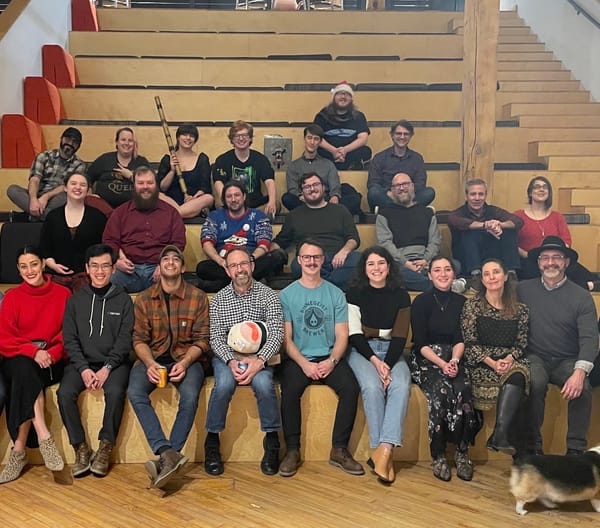
What began as a small founding group has grown into a multidisciplinary team of engineers, architects, and operators. Internally, the founders describe the team simply as builders, people who care deeply about solving real problems and seeing systems operate in the real world.
“We are hiring the people who are tired of the pilot phase,” Dooley said. “The market is beginning to realize that if you are not moving at the speed of your data, you are already behind.”
For Aplos Data, the next chapter begins this spring when the company steps out of stealth mode at the Ohio Tech Summit.
For a company born in Columbus and built around the belief that operators deserve better systems, there is no better place to begin that conversation.
The message to the Ohio business community is simple: This journey will be collaborative. Aplos Data intends to do its part, working alongside Ohio operators to build something meaningful together. One solved problem at a time.
In the age of operational AI, that approach may prove more powerful than ever.