NeuroLife launches with $2.9 million to restore hand function after stroke
The new Battelle and Ohio State spinout is commercializing a wearable, closed-loop sleeve that reads muscle signals to help patients regain grip control. Led by a veteran medtech entrepreneur, the startup is scaling up operations ahead of planned mid-2027 clinical trials.

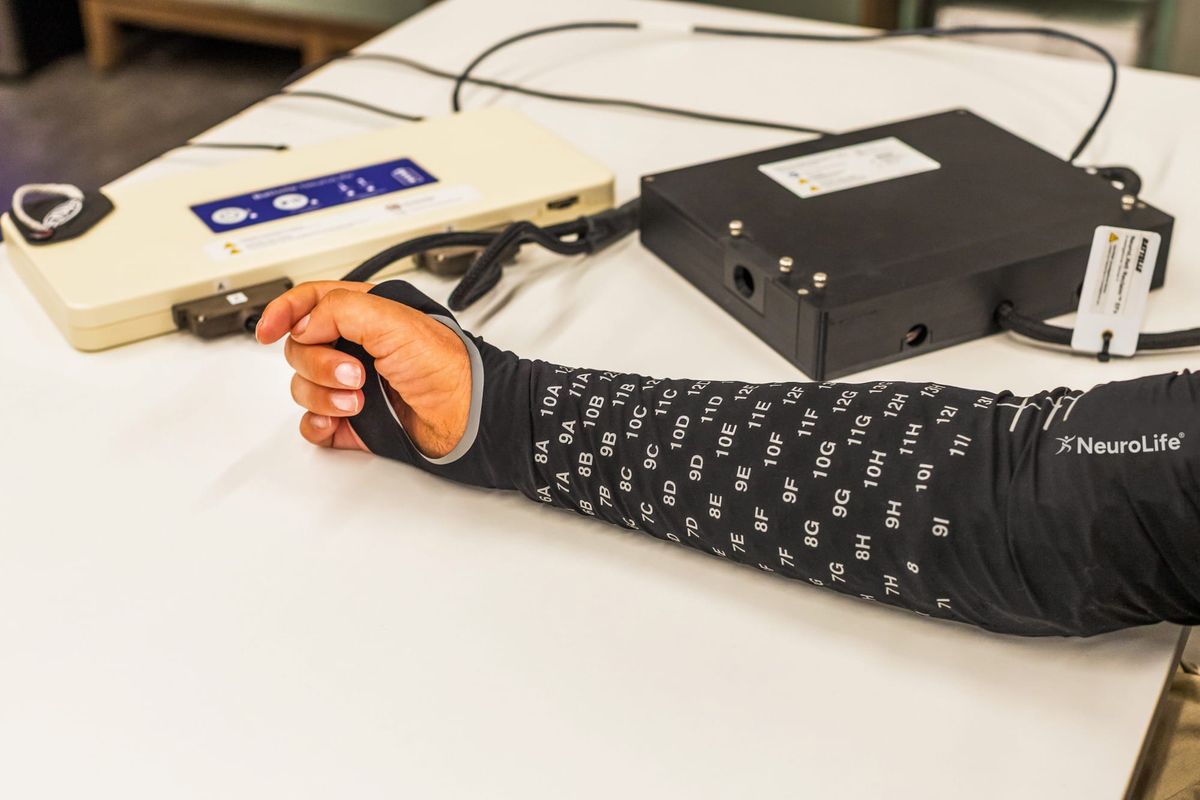
A new Columbus neurotechnology company wants to help stroke and spinal cord injury patients regain the use of their hands with a wearable sleeve.
NeuroLife launched this week as the market-facing brand of ActivateNeuro, Inc., formed through a partnership between Battelle and The NeuroTech Institute (NTI), the research organization that Battelle and The Ohio State University established in 2022. The company arrives with a $2.9 million seed round and a device built to support upper limb rehabilitation after stroke or spinal cord injury.
The company's core product is the NeuroLife Sleeve Platform, an externally worn device that reads electrical signals from muscles and nerves, interprets the movement a patient is attempting, and delivers targeted stimulation during physical and occupational therapy. The closed loop design senses and stimulates in real time to help patients regain grasp.
Leading the company is CEO Jon Snyder, who brings a long track record in the field. "As a serial entrepreneur, my background spans over 30 years in life sciences, the great majority in medtech and neuro, having raised venture capital from regional and coastal firms and strategic partners including Boston Scientific," Snyder said.
The technology itself drew him to NeuroLife. The platform was developed and patented by Battelle, giving the company a research foundation and protected intellectual property from the start. The target markets, Snyder noted, are sizable and have few good options. "The markets we are targeting (upper limb paralysis due to chronic stroke and spinal cord injury) are large, underserved populations," he said.
Roughly 7.8 million Americans are stroke survivors, according to the Centers for Disease Control and Prevention, and many face limited access to personalized, high intensity therapy. Snyder pointed to early clinical studies of the sleeve in chronic stroke and spinal cord injury patients, which he said have produced strong results.
The spinout happened now because both the institute and the research were ready, Snyder explained. NTI was created to move neurotechnology from the lab to the market, and he said the published results made the path forward clear. "We saw great technical results, with research papers published so promising that it was clear, now is the right moment," he said.
The seed round, funded by Battelle and NTI and including a license to Battelle's NeuroLife platform technology, will carry the company through its next phase. The capital will support regulatory work, reimbursement activity and engagement with the Centers for Medicare and Medicaid Services and medical societies, Snyder said, along with manufacturing scale up to support a larger study targeted for mid-2027.
The technology traces back to work with Ohio State, and the company plans to keep its base in the region even as its clinical work expands. "The foundational work we did with Ohio State was key to Battelle being able to propel the technology to the next stage," Snyder said. "We plan to stay anchored to Central Ohio, and will be conducting clinical trials here, but also will be engaging nationally as clinical trials advance."
NeuroLife is pursuing clearance from the Food and Drug Administration (FDA), with a roadmap centered on clinical validation, regulatory progress and commercial scale. The company is also recruiting partners across medtech, digital health and clinical research for co-development, clinical pilots and investment.
The launch extends a long history at Battelle of moving research into commercial use. The company has been headquartered in Columbus since its founding in 1929 and works across national security, health and life sciences, and energy and environmental fields. NTI, launched in 2022, was built to advance neurological research and bring treatments toward patients.
Snyder's near term focus is building toward a larger trial and a bigger team. The company plans to raise another round early next year to fund a larger-scale study for patients with upper limb paralysis from chronic stroke and spinal cord injury, and to expand operations as it prepares for FDA clearance.