Path Robotics unveils mobile welding system to automate heavy industry
The Columbus-based robotics startup is taking its "physical AI" off the factory floor. By pairing its Obsidian model with a quadruped robot, Path is bringing autonomous welding to the massive, immovable structures of the shipbuilding and heavy construction industries.

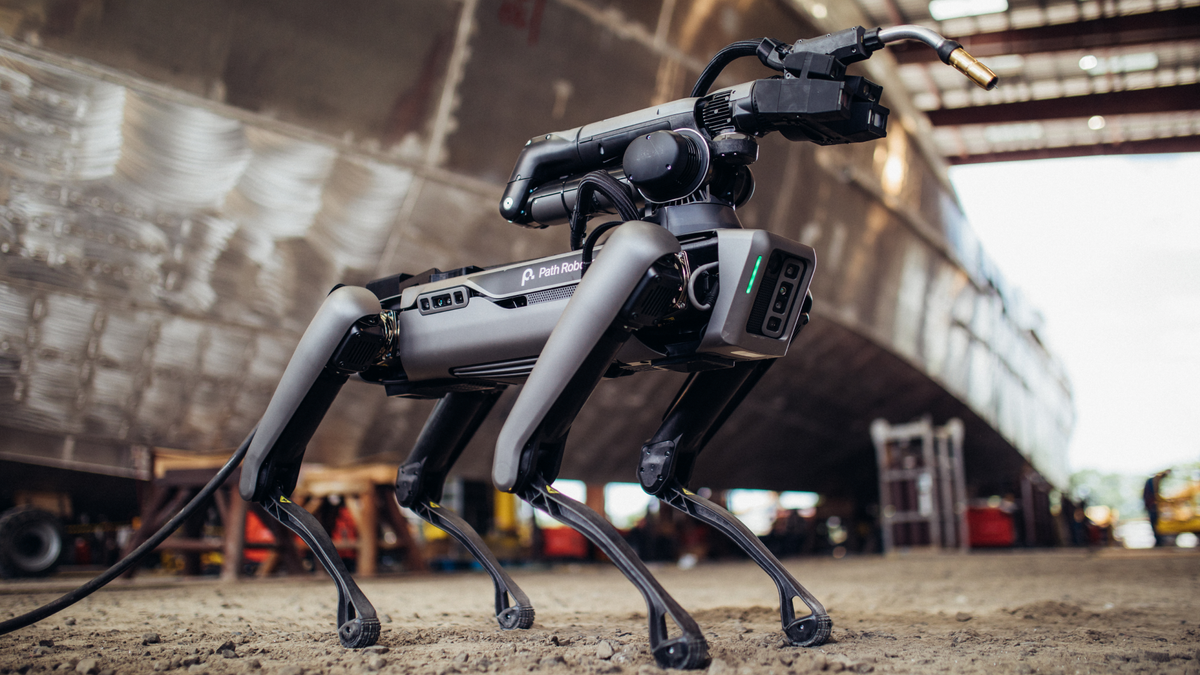
Path Robotics, one of Ohio’s leading robotics companies, is moving its technology out of the stationary factory cell and into the field. The company announced the launch of Rove, a mobile robotic welding system designed to address the historic difficulty of automating welds on large, immovable structures common in shipbuilding and heavy construction.
By mounting its proprietary "Obsidian" physical AI model onto a quadruped robot, Path aims to bridge a critical gap in industrial automation. The move represents a strategic expansion for the Columbus-based startup, which has raised more than $300 million to tackle chronic labor shortages through "physical AI"—software that allows machines to perceive and adapt to their surroundings in real-time.
The Big Idea: Trading fixed cells for field mobility
Traditional industrial robots are typically bolted to factory floors, requiring parts to be perfectly positioned within a "cell." Rove flips this model, trading fixed precision for mobile, adaptive welding that goes directly to the workpiece.
- Beyond the Cell: While Path's Obsidian model already powers autonomous welding in fixed environments, Rove allows that intelligence to navigate a production site on four legs.
- Adaptive Intelligence: The system uses computer vision to "see" and "think," allowing it to adjust to the slight variations and inconsistent fit-ups typical of massive metal assemblies.
- A New Form Factor: Legged robots have historically been considered too unstable for the high-precision requirements of welding. Path claims its AI perception layer provides the stability necessary for industrial-grade output in high-variability environments.
Why it matters
Heavy industry is currently squeezed between a surge in infrastructure demand and a dwindling workforce. In sectors like maritime and heavy construction, workpieces are often too massive to be moved, leaving them reliant on manual labor. With the American Welding Society projecting a massive deficit of skilled workers, Rove is designed to automate the tasks that were previously deemed "un-automatable."
"Rove is a significant next step and one our customers have been seeking," said Andy Lonsberry, CEO and co-founder of Path Robotics. "Manufacturers can now deploy Obsidian wherever welding is needed—across large assemblies and production sites where moving the part isn’t an option."
The early adopters
The technology is already gaining traction in the maritime sector. Saronic Technologies, a developer of autonomous maritime vessels, has signed on as one of Rove’s first early adopters.
For Saronic, the tool is a necessity for modernizing production. "Building the next generation of autonomous vessels means rethinking not just how ships operate, but also how they're made," said John Morgan, Head of Manufacturing at Saronic. The firm plans to integrate Rove into its shipbuilding operations in Franklin, Louisiana.
What’s next
Path unveiled Rove, as part of its public launch at the Sea-Air-Space 2026 expo in National Harbor, Maryland this week. Alongside the launch, Path has opened an early adopter program for manufacturers in heavy industry looking to pilot mobile automation.