Folio Photonics raises $8 million to scale optical archive storage in Solon
The Case Western spinout will use the capital to automate production of its 100-year optical discs. By slashing archive energy costs by 90%, the Solon startup aims to challenge legacy systems and capture the booming market for training massive AI datasets.

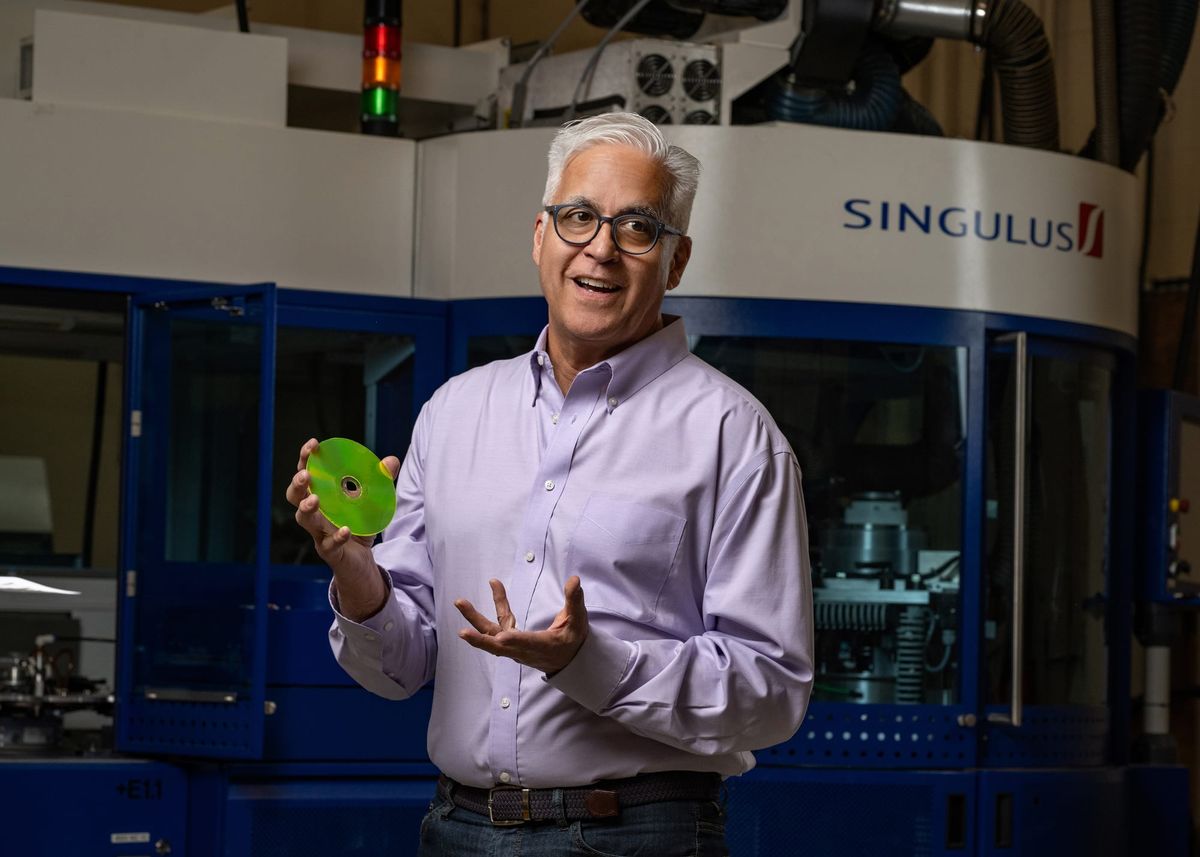
Folio Photonics has closed an $8 million Series A round to move its optical data storage technology out of the lab and toward commercial production.
The round was co-led by Material Impact and The O.H.I.O. Fund, with participation from JumpStart Ventures, Pavey Investments, Refinery Ventures, and JobsOhio Ventures. The funding will accelerate Folio's push into large-scale manufacturing in NE Ohio and support plans to acquire a facility in Solon.
Built on technology developed at Case Western Reserve University, Folio has created what it describes as the first enterprise-scale, immutable active archive solution. The company says its discs deliver a media life of 50 to 100 years and consume more than 90 percent less energy than the tape and hard disk drive (HDD) systems that dominate archival storage today, at a substantially lower cost.
Those features arrive as artificial intelligence (AI), cloud computing, and the Internet of Things (IoT) drive data growth that is straining existing infrastructure. Folio is positioning its product against two markets at once. The first is the established archival storage business, a multi-billion dollar market currently served by legacy products.
"The traditional archive storage market is a very large and well-established multi-billion dollar market with use cases that lend themselves to Folio's unique features," CEO Steven Santamaria told Ohio Tech News. "It is serviced by a variety of legacy products that we look forward to competing against."
The second is what the company calls a "knowledge layer" for AI, an emerging use case for storing the vast datasets that train and feed AI systems. Santamaria sees that opportunity as the larger long-term prize precisely because it is so new.
"It is growing at an almost unimaginable rate, and given there are no entrenched or incumbent suppliers, this represents a unique opportunity for Folio to enter the market," he noted.
The company is already in conversations with major hyperscalers, the large cloud operators that represent the most demanding buyers in the storage market. Santamaria described those relationships as early but active, with some partners offering development feedback and signaling a willingness to qualify units once Folio is ready.
"The hyperscalers are the penultimate customer, and they demand the highest quality," he explained. "The process of engaging them is very rigorous and treated with the highest level of attention."
The technology is currently transitioning from the lab to a first prototype. From there, Folio plans to step through alpha and general availability stages, deploying increasingly robust versions for testing with commercial partners and early adopters while optimizing for capacity, reliability, manufacturability, and economics. First commercial early adopter units are targeted for late 2027, with broader availability in 2028, depending on the outcome of product trials.
For The O.H.I.O. Fund, the investment reflects a thesis about keeping homegrown technology rooted in the state. Folio was invented at Case Western Reserve University, initially funded by Ohio-based early-stage investors and family offices, and built largely by Ohio employees drawing on the region's material science and polymer ecosystem.
"The state, universities, Ohio's JobsOhio economic development team, and The O.H.I.O. Fund have been instrumental in helping Folio get to where we are today," Santamaria said. "We may expand globally, but we will always be rooted in Ohio."
Manufacturing readiness sits at the center of how Folio plans to use the new capital. The company currently makes discs by hand for testing. Scaling to millions of units will require automating the full production chain, from chemical synthesis through polymer pre-processing, film coextrusion, and disc and drive fabrication. Some of that work will happen in-house, while other elements will go to third-party suppliers, many of them based in Ohio.
"Our sites and our partners' sites require technology workers for development and production, which will be instrumental in helping Ohio become a deep tech and hardware center of excellence," Santamaria said.