Path Robotics lands up to $600 million share of massive $900 million U.S. Navy shipbuilding deal
Columbus-built “physical AI” is moving from pilot to production in U.S. Navy shipyards, as HII signs a multi-year, performance-based automation deal worth up to $900 million — including a long-term, $600 million allocation that will be engineered out of Central Ohio.

Six months after initial exploratory talks, the U.S. Navy’s largest shipbuilder is turning a Columbus AI pilot into production work.
Huntington Ingalls Industries (HII) announced multi-year performance-based production agreements worth up to $900 million with Path Robotics and GrayMatter Robotics to accelerate AI-powered automation across naval shipbuilding programs. Of that total, the defense prime intends to award up to $600 million in shipbuilding work to Columbus-based Path Robotics over seven years, formalizing the exploratory MOU the two companies signed in Columbus in February.
The landmark deal transitions physical AI—software that enables robots to perceive and adapt to high-variability environments in real time—directly into the primary supply chain for aircraft carriers, submarines, destroyers, and unmanned surface vessels.
"we are defining a new approach to robotics in shipbuilding: automation that can adapt to extreme levels of complexity, mix, and size," said Eric Chewning, Executive Vice President of Maritime Systems and Corporate Strategy at HII.
The Big Picture: Scaling distributed shipbuilding
The agreements sit under HII’s High-Yield Production Robotics (HYPR) program, which aims to stitch together robotic welding, material handling, surface prep, and quality checks into a coordinated, autonomous production line. GrayMatter Robotics, based in California, will bring its "Factory SuperIntelligence" platform for surface preparation, coating, and inspection.
To support this expanded capacity, HII plans to outsource more than 2.5 million hours of shipbuilding work in 2026—a 30% increase from 2025—while building out its structural assembly network. The agreements establish a two-stage structure to validate technology before scaling up output:
- Navy-Grade Development Stage: HII, Path Robotics, and GrayMatter Robotics will collaborate to validate and qualify autonomous techniques for welding, grinding, blasting, painting, assembly, and inspection to meet stringent Navy specifications.
- Delivery Stage: Upon hitting cost, schedule, and quality milestones, HII will source actual shipbuilding work through the line, starting with small steel structures and expanding into full units and modules.
By the numbers
- Total Program Value: Up to $900 million
- Path Robotics Allocation: Up to $600 million
- Agreement Term: 7 years (performance-contingent)
- Core AI Applications: Fit-up & tack, assembly, welding, inspection
- HII Outsourcing Target (2026): >2.5 million hours (+30% YoY)
The Ohio Angle: From headquarters to high seas
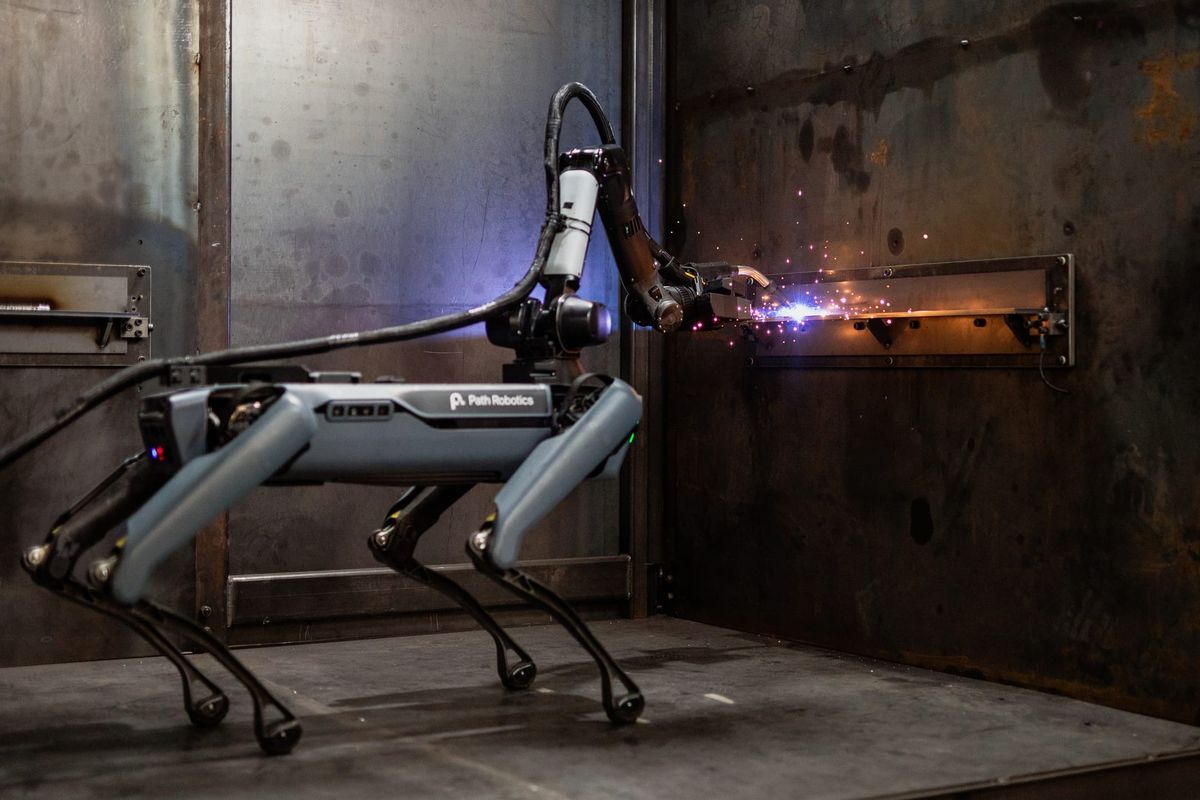
The announcement marks a rapid acceleration from February, when HII executives visited Path's Columbus headquarters to sign an initial memorandum of understanding. Since then, Path unveiled its quadruped mobile welding system, Rove™, showing its ability to move physical AI beyond stationary cells and directly onto large-scale structural assemblies.
Path's share of the agreement—up to $600 million over seven years—delivers a long-term demand signal that enables the company to make sustained investments in facilities, workforce, and its underlying physical AI architecture. Path CEO Andy Lonsberry says the agreement validates a thesis the company has been pushing since 2018.
"For years, we've believed physical AI could fundamentally change manufacturing," Lonsberry said of this announcement. "Physical AI can scale shipbuilding capacity in one of the world's most demanding production environments."
While HII constructs ships at major coastal yards in Virginia and Mississippi, some of the Navy’s most advanced shipbuilding automation will be architected in Columbus, even as it gets deployed on the coasts.