Oklo’s Ohio fuel deal brings advanced nuclear a step closer to reality
Advanced nuclear’s biggest bottleneck—fuel—may finally be easing as Oklo secures domestic HALEU from Centrus’s Piketon plant to anchor a 1.2 GW campus in Southern Ohio, linking local enrichment, new reactors, and surging AI data center demand in one project.

For years, the most consequential obstacle facing next-generation nuclear in the United States hasn’t been regulation, financing, or public opinion. It has been a quieter supply chain failure: almost no one could get the fuel they needed.
Most advanced reactor designs require high-assay low-enriched uranium — HALEU — a more concentrated form than conventional suppliers produce. Until recently, the only significant commercial source was Russia, a dependence that has functioned as a kill switch on an entire generation of American nuclear projects.
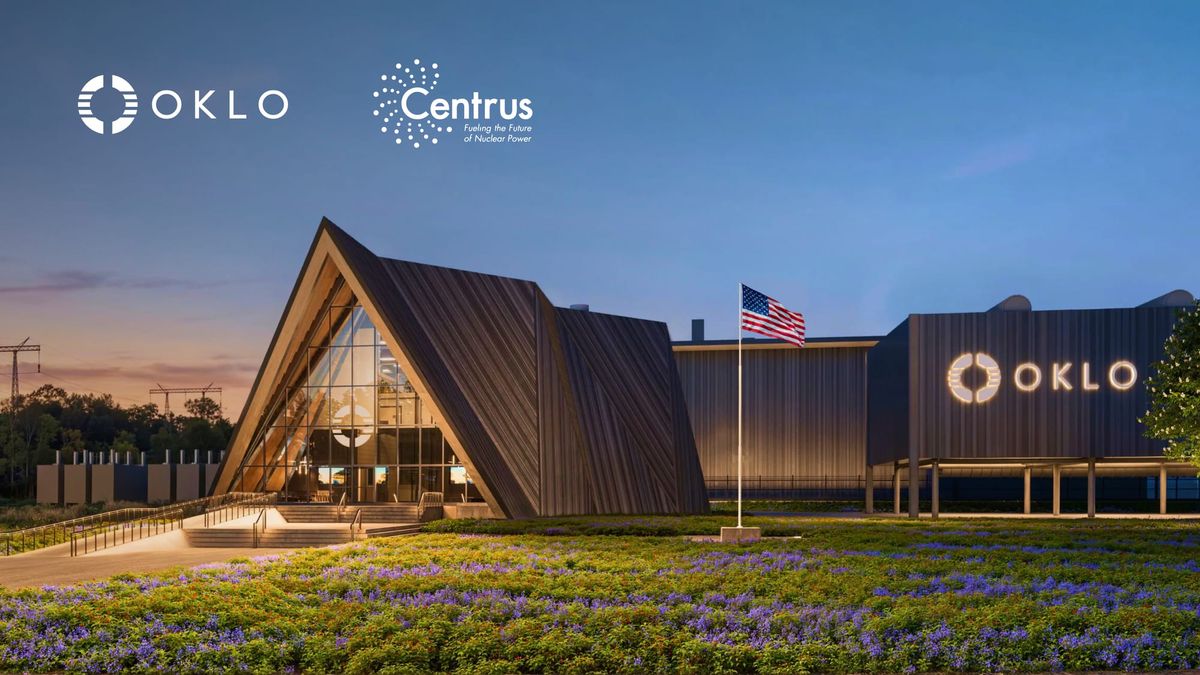
Today, Oklo Inc. and Centrus Energy Corp. signed a Letter of Intent that takes direct aim at that bottleneck. Centrus will supply domestically enriched HALEU from its American Centrifuge Plant in Southern Ohio’s Piketon — currently the only operating domestic HALEU production site — to fuel Oklo’s planned 1.2 gigawatt Clean Energy Campus in Pike County. Deliveries are targeted for 2029 and are expected to cover multiple years of fuel for up to five Aurora powerhouses, under a definitive contract still to be negotiated.
“This agreement helps establish a foundation for a new U.S. advanced nuclear energy hub,” said Centrus President and CEO Amir Vexler.
Why this deal is different
Advanced nuclear has produced a long string of promising announcements that never turned into steel in the ground. What makes this one different is that it goes straight at the problem that quietly stopped many past projects before they started.
Locking in a domestic fuel source does not guarantee Oklo will complete its campus. But without it, the campus was never going to be built.
The demand side
The load is already lining up. Earlier this year, Meta and Oklo announced an agreement to advance development of the Pike County campus to serve Meta’s Ohio data centers, including its Prometheus AI supercluster in New Albany — more than $1.5 billion in data center investment and one of the largest AI infrastructure builds in the Midwest.
Rather than building a dedicated plant next to a single data center, Oklo has entered PJM’s interconnection queue to sell power into the regional grid and settle financially with large customers. That structure means the reactors benefit the broader system while the economic value flows back to big loads like Prometheus.
Jobs and timeline
Oklo’s campus is built around modularity. Each Aurora powerhouse produces about 75 megawatts, added in phases rather than as a single billion-dollar megaproject — an approach designed to avoid the cost overruns that derailed the last wave of U.S. nuclear builds, while stretching hiring across multiple years instead of concentrating it in a short construction spike.
Oklo projects more than 700 full-time construction jobs across the build-out, plus 40 to 50 permanent operations roles per powerhouse. Centrus’s Piketon expansion adds roughly 1,000 construction jobs and 300 permanent positions, backed by a $900 million U.S. Department of Energy task order to rebuild domestic enrichment capacity.
First power is targeted around 2030. The full 1.2 gigawatt build-out is aimed for 2034.
Reactivating Piketon
None of this is happening on a blank slate. The Centrus facility sits on the grounds of the former Portsmouth gaseous diffusion plant, which enriched uranium for civilian reactors and the U.S. nuclear weapons program for decades before shutting down.
Piketon is “a nuclear town” — a place where generations of workers have already handled enrichment and fuel-cycle work, and where that knowledge can be rebuilt rather than invented from scratch. “Southern Ohio brings together decades of nuclear experience and a highly qualified workforce that can move advanced nuclear from planning to deployment,” said Oklo co-founder and CEO Jacob DeWitte.