OpenAI signs on for Pike County AI campus, commits $164 million for Ohio programs
The proposal would redevelop part of the former Portsmouth uranium-enrichment complex, pairing a major local grant fund with statewide AI-tool credits for Ohio college students while committing to fund its own grid and water infrastructure.

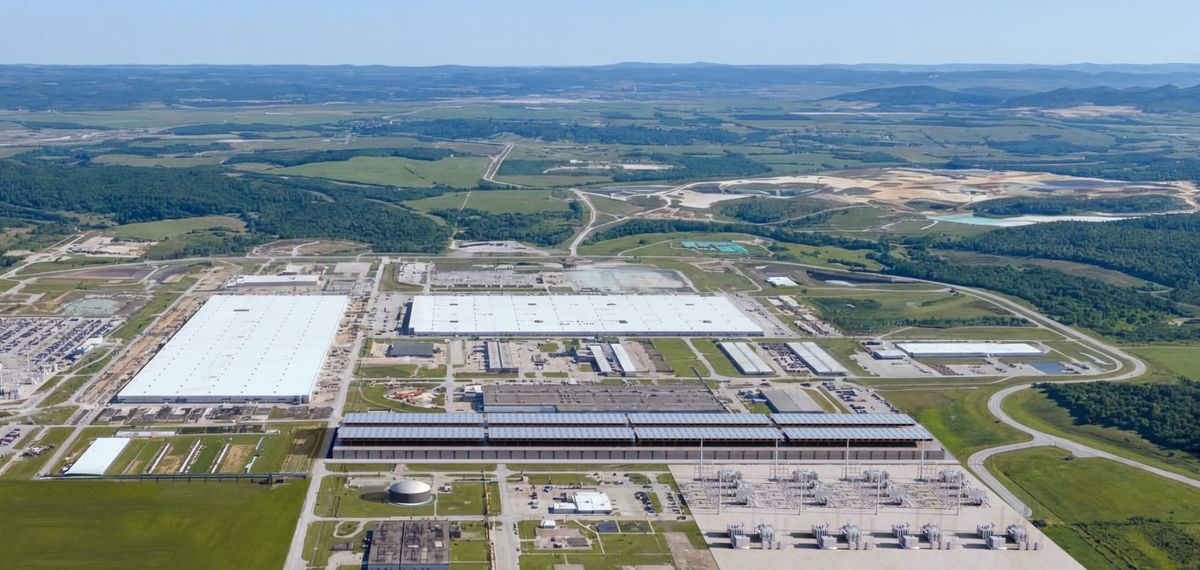
A former Cold War-era uranium-enrichment complex in Southern Ohio is set for a new role in the AI economy, after OpenAI agreed to secure about 8 gigawatts of computing capacity at a planned data-center campus in Pike County.
The PORTS-Pike Technology Campus, to be built and operated by SB Energy on private property and remediated Department of Energy-controlled land near the former Portsmouth Gaseous Diffusion Plant, would be among the largest planned AI-infrastructure developments in Ohio. NVIDIA will provide the site’s exclusive AI computing infrastructure and has committed $1.5 billion to SB Energy, while OpenAI will lease the capacity under a 20-year arrangement as it becomes available.
The agreement links an industrial site long associated with the federal uranium-enrichment complex to the escalating demand for electricity, chips and physical infrastructure needed to train and run advanced AI models. It also comes with more than $160 million in announced Ohio community and student-support commitments, including an $80 million fund for local priorities and up to $84 million in Codex credits for eligible postsecondary students statewide.
By the numbers
- 8 GW-IT: Computing capacity OpenAI has agreed to secure at the multi-phase PORTS-Pike campus.
- 35,000 / 2,500: Projected construction jobs through 2032 and long-term operating jobs, respectively.
- 800 MW: Initial capacity expected to become available in 2028, largely using existing AEP infrastructure.
- $1.5 billion / 4.25 GW-IT: NVIDIA’s planned investment in SB Energy and the initial land, power and shell capacity supported by its credit arrangement. NVIDIA has an option covering the remaining 3.75 GW-IT.
A deeper investment in Ohio
OpenAI said it will invest $40 million in a community grant fund, adding to SB Energy’s previously announced $40 million commitment. The combined fund will be guided by local residents’ priorities, including schools, public safety, health care, utilities, workforce training, housing, veterans’ services and small-business support.
Separately, OpenAI said it will make up to $84 million in Codex credits available to approximately 844,000 eligible Ohio college, community-college and technical-school students age 18 and older during the 2026-27 academic year. Eligible students would receive $100 in credits through their ChatGPT accounts to use Codex, OpenAI’s tool for software development and technical projects.
For Pike County, the commitments offer more than construction employment. The community fund creates a pool of locally directed capital around a development that will take years to build, while the credits expand the announcement’s reach to Ohio students beyond the immediate footprint of the campus.
Planning for power and water
The companies are positioning PORTS-Pike as a power-first infrastructure project, with generation, transmission and data-center capacity developed together rather than sequentially.
SB Energy and SoftBank say they will build at least 10 gigawatts of new energy generation to support 8 GW-IT of AI-factory capacity. They also plan to invest at least $4.2 billion in regional grid infrastructure through a partnership with AEP Ohio, which the companies say is structured to protect ratepayers.
The first 800 megawatts are expected to become available in 2028, largely using existing AEP infrastructure. SB Energy says it will pay for the project-specific grid upgrades and transmission lines needed to serve the campus; OpenAI said those costs will not be shifted to Ohio or regional utility customers.
The site is planned to use closed-loop, air-cooled systems that recirculate water rather than cooling towers that continually consume it. OpenAI said ongoing water use after the system is filled should be comparable to an office building serving a similar number of people and significantly below the historical water demand of the Portsmouth gaseous-diffusion plant. The company plans to publish a site-specific water estimate once it completes the final design.
OpenAI said it will issue annual reports on local hiring, community investment, water use and project-related energy consumption while working with residents, public officials, schools, businesses and labor groups on an Ohio Community Compact.