CVG builds a digital twin of its 7,700-acre campus with Columbia
Cincinnati/Northern Kentucky International Airport is the first participant in the Airports AI Alliance's Open Innovation Programme, working with Columbia University researchers and INRIX to model vehicle movement across a campus the size of a small city.

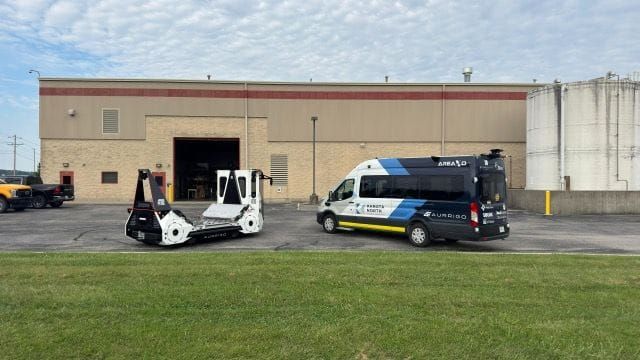
Cincinnati/Northern Kentucky International Airport is building a digital twin of its 7,700-acre campus, partnering with Columbia University's Center for Smart Streetscapes (CS3) and transportation data company INRIX to model how passenger and logistics vehicles move across a footprint airport leaders compare to a small city.
The project is the first collaboration under the Airports AI Alliance's Open Innovation Programme, which the Alliance announced Aug. 12.
How the partnership formed
Brian Cobb, CVG's chief innovation officer, connected with CS3 researchers after they presented at an Airports AI Alliance event.
"What stood out was the commonality: an airport operates like its own city, and CVG was already thinking about how to support smart streetscapes programming on our campus," Cobb said. "From there the conversation moved toward tech transferability and scalability, taking what works in a micro-metropolis like CVG and proving it could scale up to larger municipalities."
The Alliance viewed the resulting memorandum of understanding as a model worth replicating, Cobb noted, which is how CVG became the programme's first mover.
Cobb frames the partnership through what he calls a Good/Better/Best approach. Good is what the work does for CVG's own operations. Better is the regional value, since the tools and findings will not stay locked inside one airport. Best is what other airports can build once the results are public.
Modeling a 7,700-acre campus
The intent is to map how personal and logistics vehicles move across the full campus and to identify infrastructure needs before bottlenecks form, according to CVG Chief Executive Officer Larry Krauter.
Krauter pointed to growth on two fronts at once: passenger volume and CVG's position as one of the country's only dual cargo hubs. Roadway access to major highway corridors and uncongested airspace support continued flight growth, he explained, but those same advantages mean growth can outpace infrastructure without planning years ahead.
"The goal is to anticipate that growth, plan for it, and adjust so that we can continue our value proposition for businesses to locate and grow on our campus," Krauter said.
Making use of data CVG already collects
The model draws on CVG's existing camera infrastructure and data feeds, run through AI. That analysis distinguishes passenger vehicles from other forms of transit, tracks movement in and out of major campus locations, and correlates activity against flight schedules, dwell times, and congestion factors including weather and accidents.
"The value isn't new hardware for its own sake, it's finally making sense of data CVG already collects, at a speed that lets us act on it instead of just reviewing it after the fact," Krauter said.
The work extends an existing platform rather than replacing it. Enterprise Awareness and Situational Exceptions, known internally as EASE, is a CVG-built tool that centralizes multiple data streams into one view frontline staff can tailor to their roles.
"EASE already functions as a baseline digital twin without the 3D graphics, giving us an at-a-glance way to spot situational exceptions across our 7,700-acre enterprise," Cobb said. The CS3 and INRIX work adds a research-grade modeling and predictive layer on top of what EASE surfaces in real time.
Why a research partner
CS3 is a fourth-generation National Science Foundation Engineering Research Center, launched at Columbia in September 2022 on a five-year, $26 million NSF grant. Columbia leads the center in partnership with Florida Atlantic University, Rutgers University, the University of Central Florida and Lehman College. Andrew Smyth, the Carleton Professor of Civil Engineering and Engineering Mechanics at Columbia, serves as director and principal investigator.
Cobb drew a distinction between that kind of collaboration and a standard vendor contract.
"A commercial vendor optimizes for a deliverable. A research partner like CS3 optimizes for understanding the underlying problem, which means the findings hold up under scrutiny and can be published, peer-reviewed, and reused elsewhere," he said.
CS3's core expertise in street-level sensing in dense, mixed-use environments maps closely to the complexity of an airport curbfront and roadway network, Cobb added.
He also described a workforce component. CVG approaches research partnerships as a Venn diagram, looking for overlap between airport needs, institutional expertise, and regional talent development, including internships and job pathways for students coming out of programs like CS3's.
Badge holders as the first test
The memorandum of understanding is being formalized into a contracted statement of work that will define timing and deliverables, and align the project with a software-as-a-service platform CVG has in development with other partners.
Krauter said CVG's 16,000 badge holders will serve as the initial measure of success.
"They're the daily return customers who will notice and voice shortcomings immediately, long before a typical passenger would," he said, describing a crawl-walk-run rollout that moves from badge holders to partner tenants to a broader consumer-facing release.
For passengers, success may look like nothing at all. "If we do this right, passengers and airline partners won't notice a difference, even as CVG keeps growing and we mitigate traffic bottlenecks and infrastructure shortfalls before they become problems," Krauter said.
Scaling past aviation
CVG intends to bring the resulting platform to the broader transportation market, addressing movement and infrastructure questions across air, land, rail, and maritime ports. Cobb sees applications further out as well, in sports facilities, healthcare campuses, education campuses, and production facilities.
"It's also why regional partnerships like OhioX matter to us," he said. "The stronger the innovation ecosystem across Ohio and the region, the more of this kind of work happens close to home instead of somewhere else."
By the numbers
- 7,700 acres in the CVG campus being modeled
- 16,000 CVG badge holders serving as the first user group
- $26 million, five-year NSF grant behind CS3
- 5 universities in the CS3 research center
- 1st project under the Airports AI Alliance Open Innovation Programme