Ohio 4.0 campaign makes the case for Ohio's fourth economic era
The O.H.I.O. Fund has launched Ohio 4.0, a statewide campaign framing the state’s manufacturing roots as its greatest asset in the age of physical AI. The initiative argues Ohio is positioned to lead the nation's next economic era as supply chains reshore.

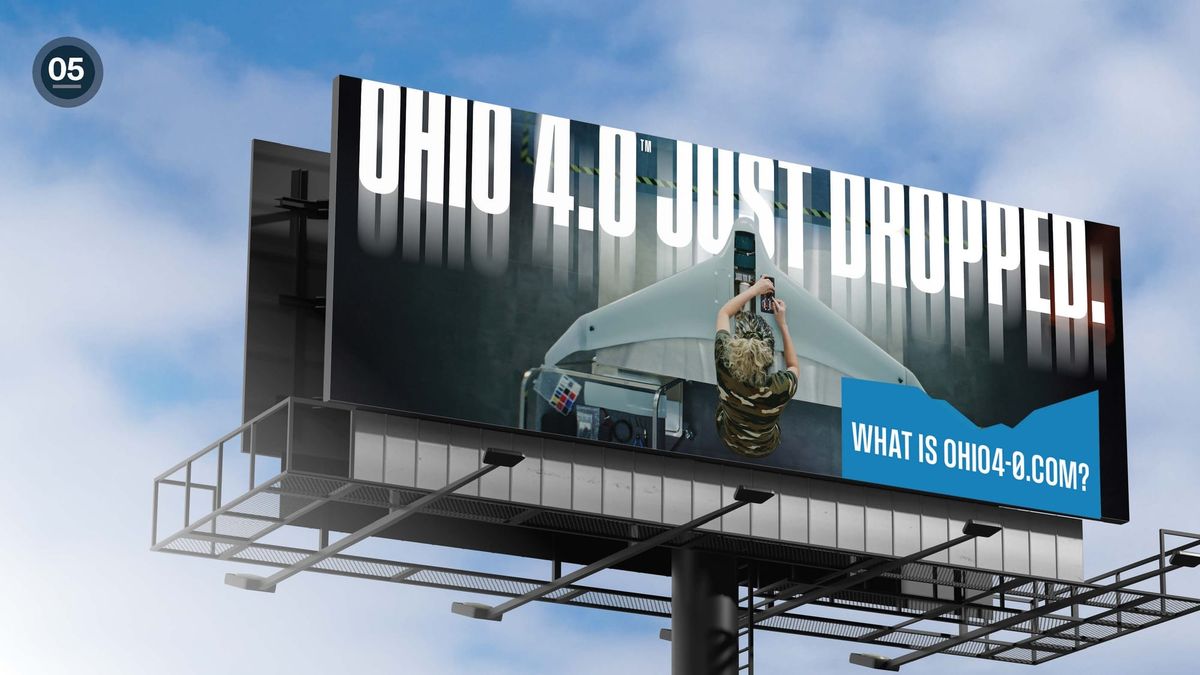
The O.H.I.O. Fund has launched a statewide advertising campaign built around a single argument: that Ohio has spent two centuries learning how to build things, and that skill is about to become the most valuable asset in the American economy.
The campaign, called Ohio 4.0, went live July 1 with billboards and digital ads across the Columbus, Cleveland, Cincinnati, Dayton, Akron and Toledo markets, directing viewers to a landing page and launch video at Ohio4-0.com. It arrives alongside a June McKinsey & Company report, "The Future of Ohio: Playing to Win in the Next Economy," which concludes that fewer than 10 states are positioned to capture the next decade of U.S. growth.
Mark Kvamme, CEO and chief investment officer of The O.H.I.O. Fund, frames the campaign as the front end of a longer effort. He arrived from Silicon Valley years ago to help start JobsOhio, and says the state's strengths were obvious to him from the outside.
"When I looked at it from a fresh perspective, it was clear Ohio was leading six or seven industries. It's one of the more diversified economies in the nation," Kvamme said. "Over the last 15 years, with JobsOhio and the legislature working together, what we're able to do now is see the fruits of that labor, and with 4.0 we're saying we've figured it out."
That phrasing is deliberate. The launch video organizes Ohio's economic history into what the fund calls the "Four F's," moving from Farms in the 1800s, to Factories through the industrial era, to Figure It Out during and after the Rust Belt decades, to the Future, the period Kvamme and his partners argue is beginning now.
Kvamme points to a mix of national and local dynamics converging at once. Global supply chains are decoupling from Asia, and reshoring is directing capital toward manufacturing capacity, an area where Ohio already holds the nation's fifth-largest base. The state's central location gives it reach into much of the country's population within a day's drive. On the policy side, he credits years of coordinated work between JobsOhio and the legislature, including tax reductions, for laying groundwork that is only now paying out. McKinsey, he noted, has worked with JobsOhio on industry strategy for years.
The pandemic, in his telling, was the hinge.
"Five years before COVID, the U.S. in general did not think manufacturing investment was necessary," Kvamme explained. "COVID exposed the supply chain risk. That began to wake people up to the need. Semiconductors, or whatever it has to be, we have to be in charge of our supply chain. Ohio has the infrastructure, the land and the workforce to make that happen."
The technology piece of the argument centers on what the fund calls physical AI, a term Kvamme uses to describe the shift from software that manages information to software that changes how physical work gets done.
"What agentic AI has done is pull all of the knowledge from the data in these models and apply it to physical tools," he said, moving the technology from knowledge-based work into the operational side of businesses.
EASE Logistics is a working example. The Dublin freight and logistics company, which The O.H.I.O. Fund invested in last year, had been booking loads manually. The fund helped implement AI to cut clicks out of the process and make individual employees more efficient, with the expectation that booking will eventually be handled entirely by AI while people shift to customer-centric roles.
"I'm a big believer that any manual, repetitive task will be improved by AI, and in this new physical AI world we will see efficiency gains," Kvamme said.
He is careful not to sell the technology as a perfect solution. There is a large volume of information sitting inside large language models, he cautioned, and not all of it is accurate, which means companies need checks and balances in place before they lean on it. The fund holds an investment in Jakib.ai, a Columbus company focused on helping businesses adopt AI responsibly, and Jakib is the partner building EASE's proprietary AI agent.
On jobs, Kvamme's position is that scaling companies will hire, though the work itself will look different than it does today. The efficiency gains, he argues, are available at scale across manufacturing and services statewide, and the businesses capturing them are the ones growing.
In late June, The O.H.I.O. Fund marked two years of fundraising and investing in the state, having raised $647 million and deployed $219 million through March 31 across 33 investments spanning companies, real estate, infrastructure and other funds.
Underneath the optimism is a warning. The main goal of Ohio 4.0 is educating Ohioans that the state is on the front edge of something significant, and that carelessness could cost it. Silicon Valley should not be allowed to outpace a state that makes things, Kvamme argues, and the question he wants every Ohio business owner asking is a simple one: what are you doing about AI, and how is it keeping you competitive?