How Franklin Park Conservatory plugged into Columbus's AI network
Launched in partnership with Experience Columbus, Satisfi Labs’ new Agentic City model connects AI across local attractions to handle 24/7 visitor inquiries. By sharing a verified knowledge base, understaffed venues can streamline operations and capture valuable zero-party data.

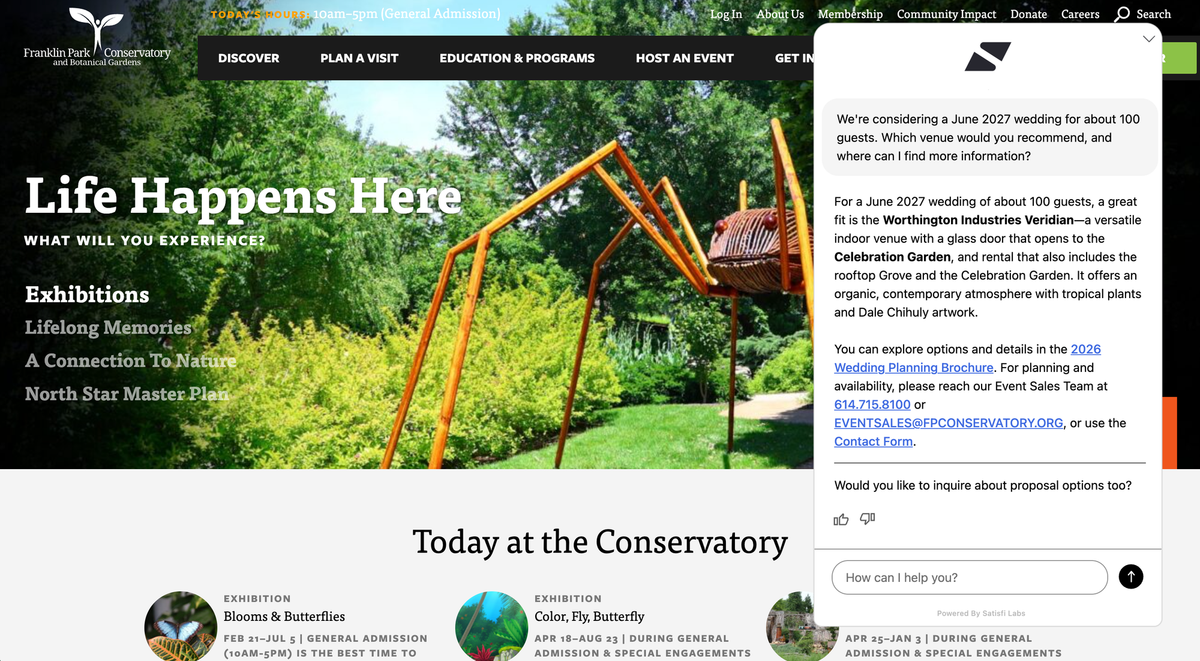
When someone messages Franklin Park Conservatory and Botanical Gardens late at night, long after the staff has gone home, the response now comes from an AI agent. The questions are routine ones about tickets, memberships, Community Days, and Museums for All eligibility, and they arrive at hours when no employee is on hand to field them. For the Columbus conservatory, that after-hours coverage is one piece of a larger experiment in how the city's attractions share information.
Franklin Park is one of the early participants in what Satisfi Labs calls its Agentic City model, a system that connects AI agents across multiple attractions and venues within a single city. The company, a conversational AI platform serving the sports, entertainment, and tourism sectors, launched the program earlier this year in partnership with Experience Columbus, the region's destination marketing organization (DMO). Columbus is the first city to adopt it.
Dan Flores, Head of Tourism at Satisfi Labs, described the infrastructure as a way to give participating organizations access to one another's knowledge so answers come from a verified source of truth. Each institution runs its own agent, but the agents can promote and reference one another. "No matter where the entry point is, Experience Columbus can surface other agents, answer those questions, and join the conversation," Flores said. The result, he explained, is a stronger experience for users and broader discoverability for the community.
That kind of connected system would be difficult for any single organization to build alone, Flores noted, pointing to the cost and staffing it would require. He credited Experience Columbus with assembling the structure needed to link stakeholders across the city, and said its readiness to go first opened the door for others. "They were the first to raise their hand," he said. Sarah Townes, Chief Marketing and Innovation Officer at Experience Columbus, said at the launch that the pilot helps destinations across the city serve guests now while building toward a more connected visitor experience.
For the cultural institutions signing on, the appeal often starts with resources. Flores said most museums and attractions operate with limited budgets and small teams, and few have the means to add staff every time demand spikes. The pitch to them was straightforward. "What if we could give you something that helps automate this 24 hours a day, seven days a week, and make the user experience better?" he said. Nearly every organization he spoke with described being understaffed, and several told him that meeting demand fully would require doubling their headcount. That staffing reality, he said, became a major driver of adoption.
The network gets stronger as more members join, and Satisfi Labs and Experience Columbus are actively engaging with attractions, venues, and cultural organizations across Columbus and the state about joining the Agentic City network, he added.
Flores called AI one of the great democratizing technology advancements, particularly for organizations that cannot throw people at every problem. Off-hours coverage is only the beginning. "Off-hours guest engagement is the low-hanging fruit," he said, noting that many people reach out after business hours. As a parent of a four-year-old, he added, "nothing gets done until 8 p.m."
The bigger opportunity, he said, is in what those conversations show about visitors. People tell the agents directly what they are looking for, a form of what Flores called zero-party data, since users willingly share their interests. Those insights can help organizations build more relevant content and experiences, and that content can in turn make them more visible in AI-powered search, where large language models (LLMs) surface and cite information. Flores said Satisfi Labs is rolling out agents that can handle transactions, such as ticket purchases, rather than only answering questions.
When Franklin Park fielded a surge during a high-demand children's event without adding staff, the harder question was whether the agent resolved those inquiries or only deflected them. Flores said the company measures outcomes. "We work on outcomes. Each agent has its own objectives and key results," he said. "Deflecting is not one of them." Satisfi Labs tracks where conversations begin, how visitors move through them, and what actions they take. "How do we take these conversations and make real business outcomes with real deliverables? That's different than just customer service," he said.
Asked what makes a city a good candidate for the model, Flores named openness and trust. Many destination marketing organizations hesitate to adopt ideas that feel future-facing, he said, and Experience Columbus stood out by embracing the concept right away. Trust among the participating organizations matters as much as size, and Franklin Park's early results helped encourage other stakeholders to join. "Size doesn't necessarily matter," he said.
Flores said the technology will reshape work. "AI is going to change jobs. It will change roles, eliminate some, and create others," he said. In tourism, where staffing shortages are persistent, he said the trade is worth it, letting organizations spend more time on the work that requires a person and less on routine information requests.